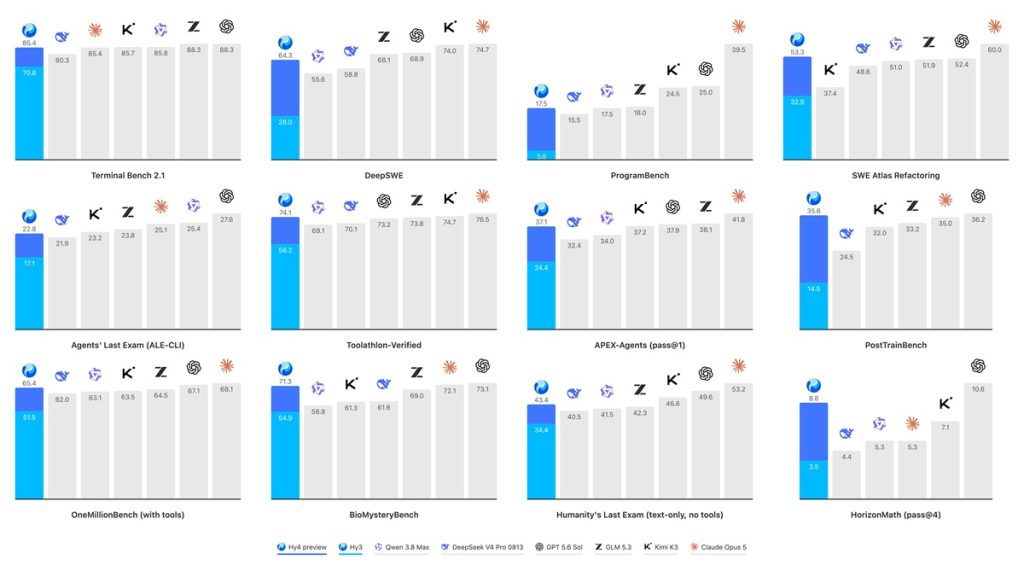
Ranked among the top tier of open-source models, Hy4 preview is built for real-world productivity tasks, delivering outstanding performance across coding, office work, and scientific research.
Tencent has released and open-sourced Tencent Hy4 preview, its next-generation large language model (LLM) featuring 770 billion total parameters, 49 billion active parameters, and a context window exceeding 1 million tokens.
The new model is designed to deliver advanced capabilities across real-world productivity workloads, including software development, office productivity, data analysis, and scientific research.
Hy4 preview is now available as an open-source model and can be accessed globally through WorkBuddy, CodeBuddy, Yuanbao, ima, and other Tencent products. Users can try the model directly through these applications or access it through APIs via Tencent Cloud TokenHub and OpenRouter.
Upon launch, Hy4 preview will be available for free on WorkBuddy and CodeBuddy for two weeks. Tencent has also extended free access to Hy3 on both platforms until September 30.
A Major Expansion in Scale, Context, and Training
Hy4 preview represents a significant expansion in model size, context length, and training-data volume. Advances in both pre-training and post-training have contributed to a substantial improvement in overall intelligence, positioning Hy4 preview among the top tier of open-source models.
The Hunyuan team has continued to work through deep co-design with products such as CodeBuddy and WorkBuddy, with the goal of optimizing the real-world user experience across a wide range of productivity scenarios.
In a blind internal evaluation conducted by Tencent involving 163 experts and 203 engineering tasks, Hy4 preview achieved an average score of 2.99 out of 4.00, slightly ahead of GLM-5.3 at 2.92/4.00 and Kimi K3 at 2.94/4.00.
Designed Around Real-World Productivity
Hy4 preview was developed with productivity as a central focus. Its training incorporated high-quality data co-created with Tencent experts across fields including software engineering, gaming, finance, security, and other domains, alongside deep co-design with products such as WorkBuddy.
This approach has helped the model deliver improvements across a broad range of real-world productivity tasks.
Software Engineering
In software engineering, Hy4 preview provides stronger capabilities in understanding, planning, debugging, and validation for long-context development tasks.
The model also improves the visual quality and interaction experience of front-end development, helping developers work more effectively across complex software projects.
Office Productivity and Data Analysis
For office productivity and analytical workloads, Hy4 preview demonstrates a stronger understanding of complex working environments while offering enhanced capabilities for financial analysis.
The model has also been optimized for data analysis and cross-document collaboration, supporting workflows that extend from processing information to creating documents, spreadsheets, and presentations.
Game Development
In game development, Hy4 preview can generate a playable prototype from a single natural-language request and work effectively with game engines.
Developers can then continue refining increasingly complex game projects through multi-turn interactions, enabling the model to support development beyond initial prototyping.
Scientific Research
Hy4 preview also targets demanding scientific workloads, with stronger capabilities in understanding, reasoning through, and solving complex research problems.
Notable improvements span areas including AI research and development, molecular dynamics simulation, condensed-matter physics, and fundamental mathematics.
Hy4 Preview Contributes to Its Own Development
One of the more notable aspects of Hy4 preview is its participation in its own development process.
For the first time, the model contributed to the automated optimization of training methods, data strategies, evaluation frameworks, and low-level operators.
The model proposed approaches, ran experiments, and iterated based on the resulting outcomes. The resulting code, logs, and feedback were then incorporated into subsequent rounds of exploration, establishing what Tencent describes as an early-stage recursive self-improvement loop.
Hy4 preview also autonomously analyzed bottlenecks within its inference system and conducted multiple rounds of optimization in areas such as operator fusion and communication optimization.
According to Tencent, these improvements increased end-to-end throughput by 31.8% compared with the baseline, with consistent gains across different context lengths and concurrency levels.
The results demonstrate the model’s ability to autonomously optimize aspects of the infrastructure used to run its own inference.
Cost-Efficient Access to Advanced AI
Despite its scale and capabilities, Hy4 preview continues to emphasize cost efficiency, helping make advanced AI more accessible to developers and businesses.
Its API pricing is set at:
- USD 0.834 per million input tokens
- USD 2.501 per million output tokens
- USD 0.042 per million tokens for cache hits
Building the Next Generation of Hunyuan Models
Tencent says its preview-first approach, followed by official model releases, allows the Hunyuan team to continuously incorporate real-world user feedback into its research and development process.
By exposing models to real-world problems and workflows, the company aims to use practical feedback to drive continuous improvements in its AI systems.
With Hy4 preview now open-sourced and available across Tencent’s ecosystem and API platforms, the company is positioning the model as another major step in its broader push toward highly capable, cost-efficient AI for real-world applications.
The next batch of models in the Hy4 series is expected to roll out soon.