Long before Spanish colonization, communities across the Philippine archipelago had already developed distinct burial traditions—from ancient cremation practices to elaborately decorated burial jars that reveal how they understood death, remembrance, and the afterlife.
As Undas approaches, millions of Filipinos prepare to visit cemeteries, light candles, offer flowers, pray for departed loved ones, and reunite with family members. Yet the history of honoring the dead in the Philippines stretches far beyond the familiar observances of November 1 and 2.
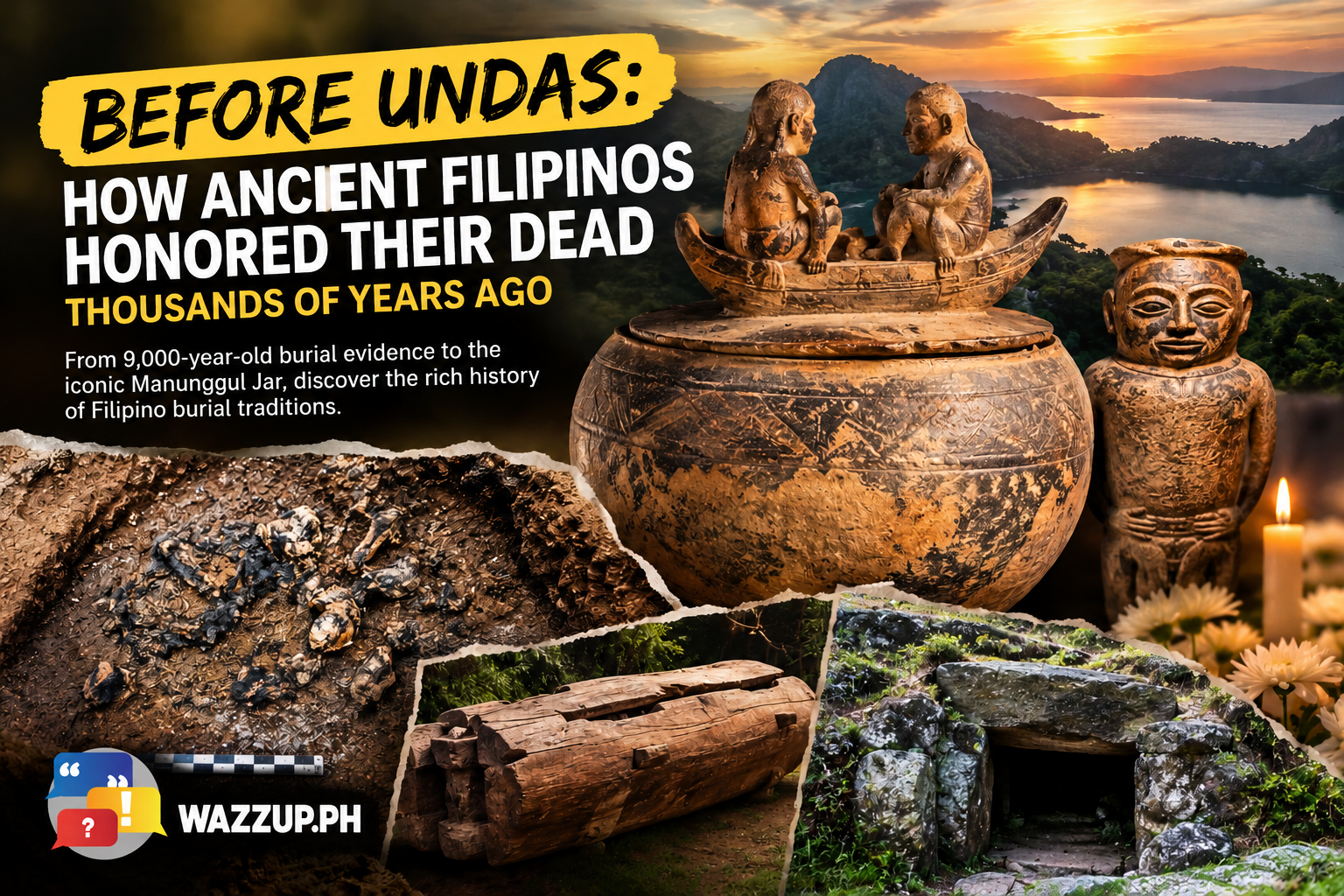
Archaeological discoveries across the archipelago reveal that communities were practicing deliberate burial rituals thousands of years before Spanish colonization. Cremated remains, earthenware burial jars, wooden coffins, and limestone tombs offer glimpses into the beliefs and traditions of people who lived long before the arrival of Christianity.
These discoveries show that the history of remembering the dead in the Philippines did not begin with Undas as it is observed today. Instead, modern customs developed through centuries of cultural exchange, religious influence, and local adaptation.
ILLE CAVE: EVIDENCE OF BURIAL RITUALS 9,000 YEARS AGO
One of the most significant archaeological discoveries related to early burial practices in the Philippines comes from Ille Cave in El Nido, Palawan.
Researchers identified evidence of a cremation burial dating to approximately 9,500 to 9,000 years ago. The discovery, documented in archaeological research, is among the earliest known evidence of deliberate funerary practices in the region.
The remains showed signs of burning and subsequent handling before being placed in a container for burial. This suggests that the treatment of the dead involved deliberate actions rather than simple disposal.
Another important site, Bubog Cave in Mindoro, has yielded evidence of flexed burials, in which bodies were placed with their limbs bent. These discoveries demonstrate that early communities across the archipelago employed different methods of treating their dead.
However, the earliest known burial evidence should not be confused with the earliest cemetery. Archaeological discoveries establish that funerary practices existed, but they do not necessarily reveal when organized cemeteries first emerged.
THE MANUNGGUL JAR: A POSSIBLE SYMBOL OF THE JOURNEY AFTER DEATH
Among the Philippines’ most celebrated archaeological treasures is the Manunggul Burial Jar, discovered in Manunggul Cave within the Tabon Cave complex in Palawan.
Dating to approximately 890 to 710 BCE, the jar is associated with secondary burial—a practice in which skeletal remains are transferred to another container or resting place after an initial burial.
Its distinctive lid features two human figures seated in a boat. The design is widely interpreted as representing the journey of the dead toward the afterlife, although interpretations of ancient symbolism must be approached with care.
The jar’s craftsmanship, intricate decoration, and carefully sculpted figures demonstrate the artistic skill of its makers. It also provides evidence of the symbolic importance that burial objects held in some ancient communities.
The Manunggul Jar is not the oldest known burial evidence in the Philippines. Rather, it is one of the most recognizable examples of the archipelago’s ancient funerary art.
Another remarkable discovery is the collection of anthropomorphic burial jars from Maitum in Sarangani. These vessels were shaped to resemble human figures, with distinctive facial expressions and other individual features.
Together, the Manunggul and Maitum jars reveal the diversity of burial traditions and artistic expression among ancient communities.
WOODEN COFFINS AND LIMESTONE TOMBS REVEAL DIVERSE TRADITIONS
Ancient Filipinos did not follow a single burial system. Practices varied across regions, communities, historical periods, and cultural beliefs.
Archaeological sites in the Philippines have yielded wooden coffins dating from approximately the twelfth to fifteenth centuries. Some were made from hollowed tree trunks and featured distinctive shapes and decorative details.
In Mulanay, Quezon, the Mount Kamhantik archaeological site contains limestone burial structures associated with a settlement dating to roughly the late ninth through early eleventh centuries, based on archaeological dating evidence.
These structures demonstrate another approach to burial: carving receptacles directly into limestone formations.
Other discoveries across the archipelago include burial vessels made of earthenware and limestone, as well as burial places in caves, coastal areas, and inland settlements.
Rather than revealing one unified tradition, these archaeological remains demonstrate how different communities developed their own ways of handling and commemorating the dead.
HOW SPANISH COLONIZATION TRANSFORMED BURIAL CUSTOMS
Spanish colonization introduced Catholic institutions and religious observances that gradually reshaped funeral and burial practices in many parts of the Philippines beginning in the sixteenth century.
Churches became important centers of religious life, and burial grounds were commonly established within or near church complexes. Some prominent individuals were buried inside churches, while other members of the community were interred in churchyards.
By the nineteenth century, concerns about overcrowding and public health contributed to colonial efforts to relocate burial grounds away from churches and densely populated town centers. These changes also reflected broader questions about religious authority, social status, and the administration of colonial communities.
Catholic observances associated with All Saints’ Day on November 1 and All Souls’ Day on November 2 became deeply embedded in Filipino religious and cultural life.
Over time, Filipinos adapted these observances to local customs and family traditions. Indigenous practices persisted in some communities, while others changed or disappeared.
The result is a layered history in which religious observances, local customs, and family practices have shaped the ways Filipinos remember their departed.
FROM CORDILLERA COFFINS TO BURIAL JARS: A DIVERSE CULTURAL HERITAGE
The Philippines’ funerary heritage extends beyond the archaeological sites of Palawan, Mindoro, and Mindanao.
In parts of the Cordillera, hanging coffins associated with particular indigenous communities remain among the best-known examples of distinctive burial traditions. These practices are specific to certain cultural groups and should not be generalized to every community in the region.
Other communities have maintained or adapted traditions involving extended wakes, communal gatherings, chants, prayers, and ritual observances. The details vary across cultural groups and have changed over time.
Meanwhile, archaeological discoveries of burial jars in Palawan and Mindanao, along with wooden coffins in other parts of the country and limestone tombs in Quezon, demonstrate the wide range of materials and methods used in the treatment of the dead.
Although some ancient traditions may resemble elements of modern Undas, similarities alone do not prove that present-day customs descend directly from specific prehistoric practices.
What the evidence does establish is that communities throughout the archipelago developed meaningful and varied ways of treating their dead long before Spanish rule.
WHAT ANCIENT BURIAL SITES TELL US ABOUT UNDAS TODAY
For many Filipino families, Undas is a time to return to ancestral graves, offer flowers, light candles, attend Mass, pray, and gather with relatives. It is also an opportunity to share family stories and introduce younger generations to loved ones they may know only through photographs and memories.
Archaeological discoveries provide a deeper historical perspective on this familiar observance.
Long before the Spanish colonial period, people living in what is now the Philippines were already practicing burial rituals shaped by their beliefs, environments, and communities. Their traditions took many forms, from cremation and secondary burial to decorated jars, wooden coffins, and limestone tombs.
Modern Undas is not simply an unchanged continuation of these prehistoric practices. It reflects centuries of religious influence, cultural exchange, and local adaptation.
As families prepare to remember their departed this November, these discoveries offer an opportunity to explore the country’s cultural heritage, learn about the traditions of different communities, and respect indigenous sacred places and burial grounds.
The ancient jars, coffins, and tombs discovered across the archipelago are more than archaeological artifacts. They are tangible evidence of communities that lived, mourned, and developed their own traditions of honoring the dead long before the Philippines became a Spanish colony.
Before Undas took its familiar form, the people of this archipelago already had their own ways of honoring the departed. Their stories remain part of the country’s history—and a reminder that the roots of remembrance run deep.