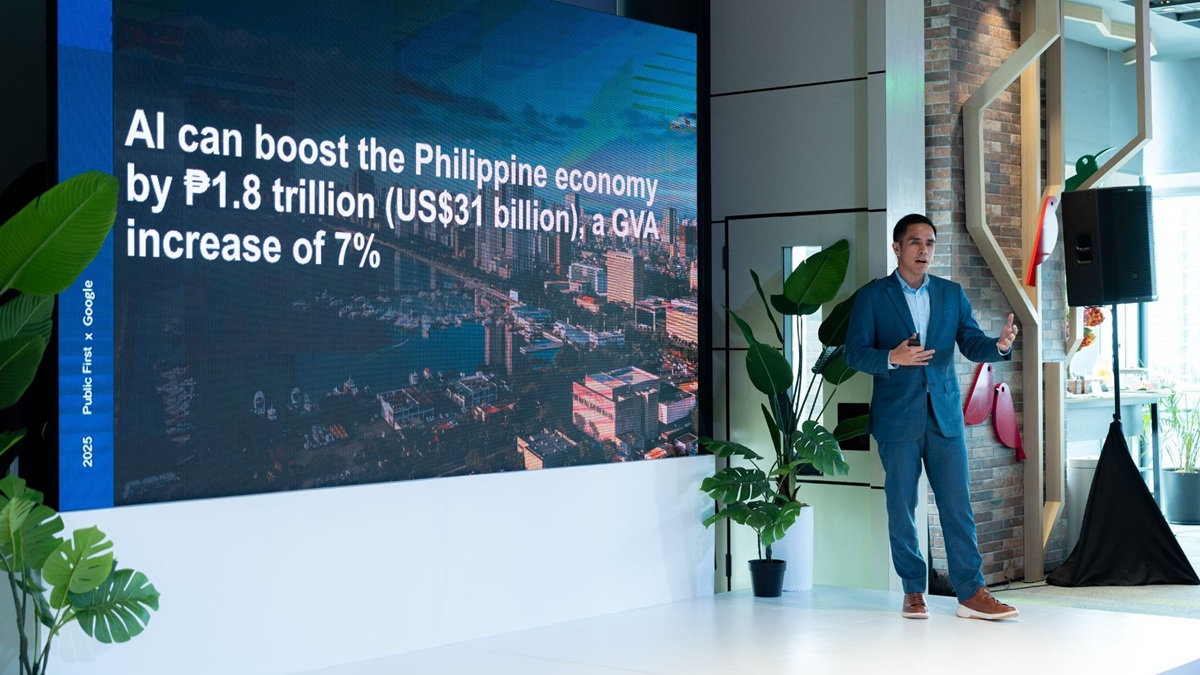
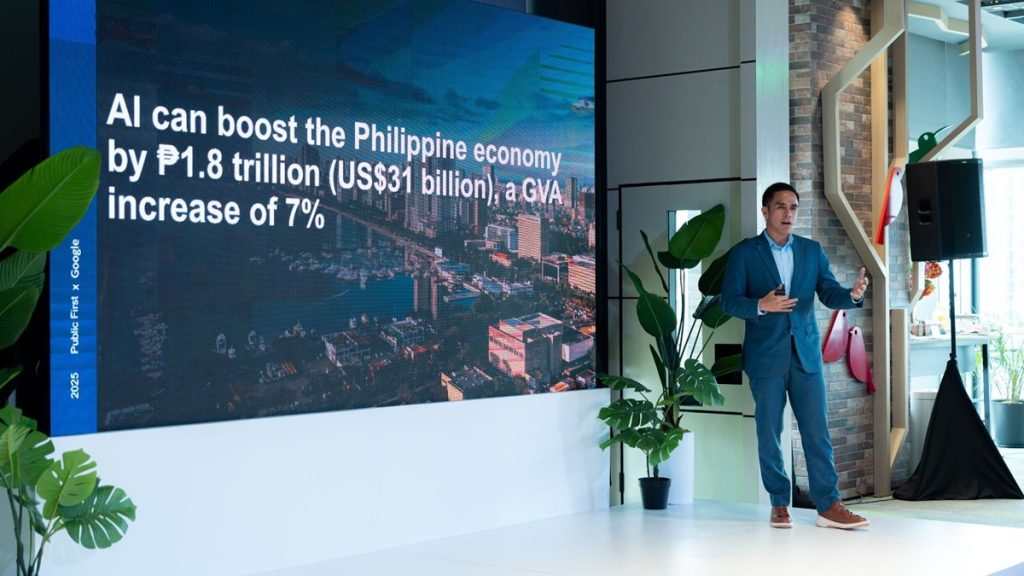
The Philippines — already Southeast Asia’s fastest-growing digital economy — stands at the threshold of a major economic transformation driven by artificial intelligence. A new study by London-based public policy research agency Public First, titled Turbocharging Growth: The Philippines’ AI Opportunity, estimates that AI could eventually add ₱1.8 trillion (about US$31 billion) to the nation’s economy — roughly a 7% lift in gross value added (GVA).
The report, launched today, makes a clear case: AI is not just a productivity booster for businesses, it is also a nationwide growth engine that can raise wages, create new high-value roles, and help solve real social challenges — but only if the right policies, partnerships, and upskilling programs are in place.
Widespread use, rising optimism
AI is already woven into many Filipino lives. The study finds that about half of the population uses AI tools at least once a week, while public sentiment is upbeat: 46% of Filipinos say they’re optimistic about AI’s national potential and 50% expect positive personal impacts. That familiarity creates fertile ground for wider adoption — provided people have access to trustworthy tools and training.
Where the economic gains come from
Public First maps out how productivity improvements driven by AI could flow through the economy:
- 37% of the workforce could be significantly augmented by AI, freeing up to three hours per week of administrative time for the average worker.
- That time savings could translate into wage increases of over 6% and add on average over ₱110,000 to a worker’s annual productivity value.
Sector highlights with projected gains include:
- Wholesale & Retail — potential ₱410 billion uplift (≈ 9% GVA increase)
- Finance & Insurance — potential ₱300 billion uplift (≈ 12% GVA increase)
- Public Administration & Defense — potential ₱109 billion uplift (≈ 9% GVA increase)
Beyond these headline numbers, the report underscores AI’s practical contributions: cutting cybersecurity costs roughly in half (saving as much as ₱180 billion) and boosting agricultural productivity by ₱120 billion by 2035 via precision farming and early pest detection.
Jobs, not just automation — a shift in work content
Contrary to the fear that AI will simply erase jobs, the study projects a reshaping of work: routine administrative tasks will decline while demand increases for roles that manage AI tools, interpret outputs, and perform higher-value, creative, or complex problem-solving work. That transition raises a single, urgent priority — upskilling.
Notably, the report finds that 90% of workers expressed interest in training to better understand how AI models work — a clear signal that Filipinos are ready to learn new skills if opportunities are available.
Partnerships to build an AI-ready workforce
Tech companies and employers are already stepping up. Google reaffirmed its commitment to skilling Filipinos with programs like Google Career Certificates (including AI Essentials), delivered in partnership with government agencies such as the Department of Trade and Industry and the Department of Information and Communications Technology, as well as industry groups like IBPAP. These courses have been made available to employees, civil servants, and partner communities.
“AI is more than a buzzword — it’s a powerful tool that can help every Filipino,” said Gabby Roxas, Country Marketing Manager for Google Philippines and Vietnam. Google is also enabling partner organizations, such as Accenture, to use its Career Certificates to upskill communities and families connected to Accenture’s network.
Accenture, a major Philippine employer, also confirmed its focus on training: the firm works across government, industry, and academia to develop a diverse talent pipeline for an AI era. Rudy Guiao, Accenture Philippines’ Managing Director and Corporate Citizenship Lead, emphasized that investing in AI education is central to promoting digital inclusion and equitable growth.
The policy and business agenda: what needs to happen next
Public First’s report stresses that realizing the ₱1.8 trillion opportunity will require coordinated action across several fronts:
- Scale up accessible training and re-skilling programs targeted at current workers and young talent.
- Embed AI responsibly across public services (e.g., precision agriculture, cybersecurity) with clear governance and ethical safeguards.
- Support SMEs in adopting affordable AI tools so gains aren’t limited to large firms.
- Strengthen data infrastructure and digital trust — secure data flows and robust cyber defenses are essential.
- Public-private collaboration to design curricula, apprenticeships, and incentives that accelerate workforce transformation.

Bottom line
The Philippines has both the digital momentum and the public appetite to harness AI for growth. Public First’s analysis shows enormous upside — higher productivity, sectoral gains across retail, finance, public services, and agriculture, and new, higher-value job opportunities — but the payoff depends on how quickly the country can mobilize training, responsible AI governance, and inclusive adoption.
With major industry players like Google and Accenture already investing in skills partnerships, the blueprint for an AI-ready Philippines is beginning to take shape. The report’s message is clear: the technology can turbocharge growth — but only if policymakers, businesses, educators, and communities act together to ensure the benefits are widely shared.