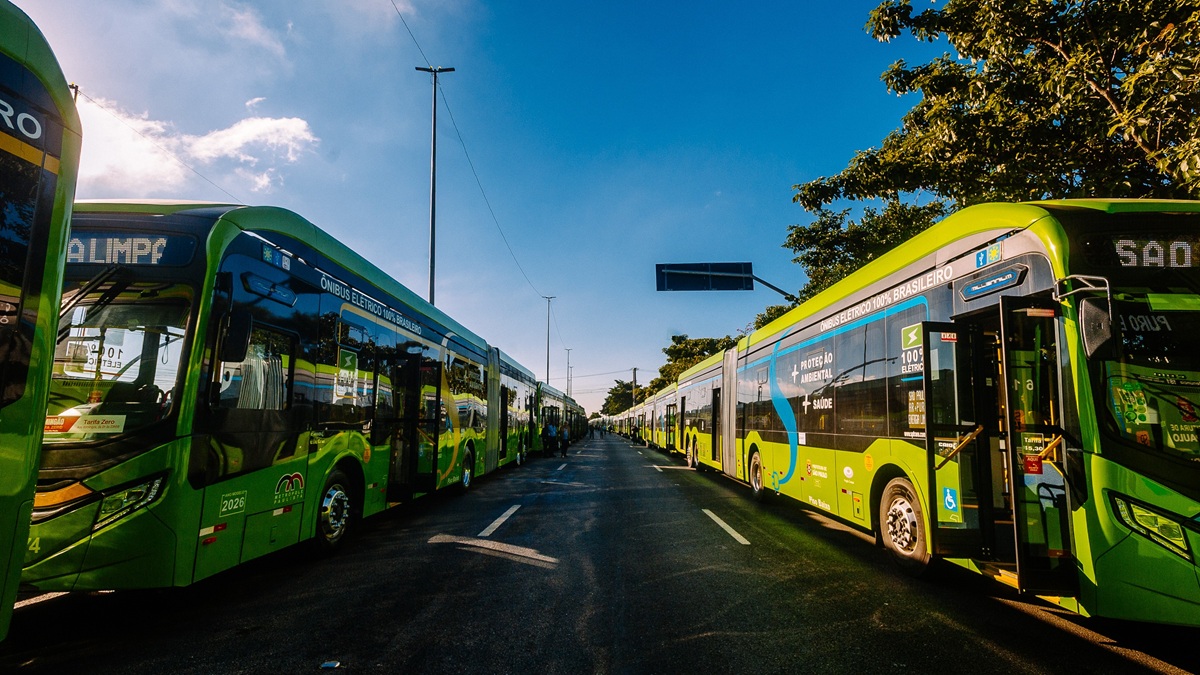
São Paulo now has the second-largest electric bus fleet in Latin America and, together with more than 80 cities, is helping avoid an estimated 10 million tonnes of CO₂ emissions every year.
Cities across Latin America have reached a historic milestone of 10,000 electric buses in operation, according to consolidated data from E-Bus Radar, announced by C40 Cities and the International Council on Clean Transportation (ICCT) during Lat. Bus 2026, the region’s largest transport and mobility event.
The achievement marks a major turning point in the decarbonization of public transportation across the continent, reinforcing electric mobility as a practical response to the climate crisis while improving air quality and the health of urban communities.
The milestone reflects the coordinated efforts of 80 cities across 13 Latin American countries, which have accelerated the electrification of their public transport fleets in recent years. Santiago, São Paulo, and Bogotá currently lead the region, with more than 7,000 electric buses combined. São Paulo now has the region’s second-largest electric bus fleet.
Together, the electric buses operating across these cities are estimated to prevent more than 10 million tonnes of CO₂ emissions annually.
Brazil Accelerates Its Electric Mobility Transition
In Brazil, the shift toward zero-emission public transportation has gained momentum through initiatives such as the ZEBRA Alliance, as well as cities supported by the Mutirão Brazil Program, a joint initiative of C40 Cities and the Global Covenant of Mayors for Climate & Energy (GCoM).
Through these programs, Brazilian mayors are adopting zero-emission technologies to modernize public transportation, improve air quality, and accelerate urban decarbonization.
Since 2019, C40 Cities and ICCT, through the ZEBRA Partnership and alongside other partners, have supported São Paulo and other cities—including Bogotá, Mexico City, Salvador, and Curitiba—in developing and structuring financing models for electric mobility.
The long-term collaboration has helped connect municipalities with financing institutions and vehicle suppliers, contributing to lower capital costs and unlocking large-scale procurement of zero-emission buses.
Ilan Cuperstein, C40 Cities Regional Director for Latin America, said:
“Reaching 10,000 electric buses in operation shows that the transition to zero-emission transport is no longer a promise but a reality in Latin American cities.”
He added that electric buses are delivering direct benefits for the climate, public health, public transport quality, and local economies, while demonstrating that financing does not have to be a barrier for cities pursuing clean transportation.
São Paulo: A Financing Model to Be Replicated
Few cities demonstrate the potential of this transition better than São Paulo.
In June 2026, the Brazilian capital added 500 new electric buses in a single delivery, bringing its fleet to 1,759 electric buses, the largest electric bus fleet in Brazil. This includes 1,570 battery-electric buses and 189 trolleybuses.
The fleet is estimated to prevent approximately 130,000 tonnes of CO₂ emissions each year and save around 57 million liters of diesel annually—an environmental impact equivalent to planting approximately 11 million trees.
Beyond the size of its fleet, São Paulo also stands out for the financing structure supporting its transition. The municipality established an investment program worth approximately R$6.5 billion, combining national and international resources with participation from institutions including the Brazilian Development Bank (BNDES), the World Bank, and the Inter-American Development Bank (IDB).
The city has also embedded electrification into permanent public policy. Under municipal regulations, operators can no longer replace vehicles reaching the end of their useful life with new diesel buses, helping ensure a progressive transition toward low- and zero-emission technologies.
Today, São Paulo’s electric fleet serves a portion of the more than 7 million passengers transported every day through the municipal public transport system.
Ricardo Nunes, Mayor of São Paulo, highlighted:
“We are accelerating the energy transition of the country’s largest city and consolidating a public policy that is already a national and international benchmark.”
He noted that the delivery of 500 electric buses in June represents the environmental equivalent of planting 3.2 million trees per year, while avoiding 45,000 metric tons of CO₂ emissions and reducing annual diesel consumption by approximately 20 million liters.
A Viable Pathway for Other Cities and Regions
The São Paulo experience offers a potential roadmap for other cities: combine fleet-renewal regulations, clean vehicle deployment, and financing mechanisms that reduce the initial investment burden on municipalities.
This combination of stronger regulation and strategic technical assistance from city networks is also at the heart of efforts by C40 and GCoM to expand programs such as Brazil Mutirão. These initiatives support local governments in financial modeling, resource mobilization, and the integration of monitoring tools.
Beyond São Paulo, cities including Salvador, Recife, Belo Horizonte, and Rio de Janeiro are advancing electrification projects with support from C40 and other members of the ZEBRA Alliance.
In Rio de Janeiro, the program is helping the city government prepare terminals across the Rio System for future electric buses, including studies on charging infrastructure, economic and financial modeling, and project structuring.
In Salvador, Mutirão Brasil is supporting the city’s goal of electrifying at least half of its BRT fleet.
In Recife, collaboration across government levels resulted in the formalization of a R$319 million investment from the Federal Government to purchase 100 electric buses and charging infrastructure for the Metropolitan Region. Brazil Mutirão, working with the Ministry of Cities, supported the review of procurement terms, economic modeling, and validation of the routes that will receive the vehicles.
Meanwhile, in Belo Horizonte, efforts are focused on deploying the infrastructure needed for electric mobility. The city is commissioning 27 chargers at bus depots, enabling the operation of approximately 100 of the capital’s first electric buses. Funded through the New PAC program, the project also includes technical assistance for monitoring, validation, and commissioning of the charging infrastructure.
Together, these initiatives demonstrate that reaching 10,000 electric buses is not an endpoint, but another milestone in a rapidly expanding transition. As innovative financing models, stronger policies, and cooperation among different levels of government gain momentum, Latin America’s shift toward cleaner, more efficient, and more sustainable public transportation is poised to accelerate.