An analysis of over 850,000 job advertisements shows that modern hiring heavily favors expertise in cloud platforms and foundational infrastructure. Employers are consistently hunting for professionals who can manage and scale these core technologies.
Vilnius, Lithuania — Even as the U.S. job market registers its sharpest monthly decline in over a year, the core competencies sought by technology employers remain remarkably stable. For tech professionals looking to strategically upskill, the actual hiring demands of the industry continue to hold steady despite wider economic headwinds.
According to a fresh study by web intelligence company Oxylabs, an evaluation of approximately 850,000 U.S. technology job advertisements, spanning January 2025 to March 2026 revealed a clear trend. Instead of viral social media technologies, employers are overwhelmingly prioritizing expertise in cloud platforms and fundamental infrastructure tools.
Amazon Web Services (AWS) appears in 30% of all postings. It is followed by Microsoft Azure (24%), Git (21%), Excel (15%), Google Cloud Platform or GCP (14%), Kubernetes (14%), Docker (13%), Power BI (9%), Terraform (8%), and Tableau (7%).
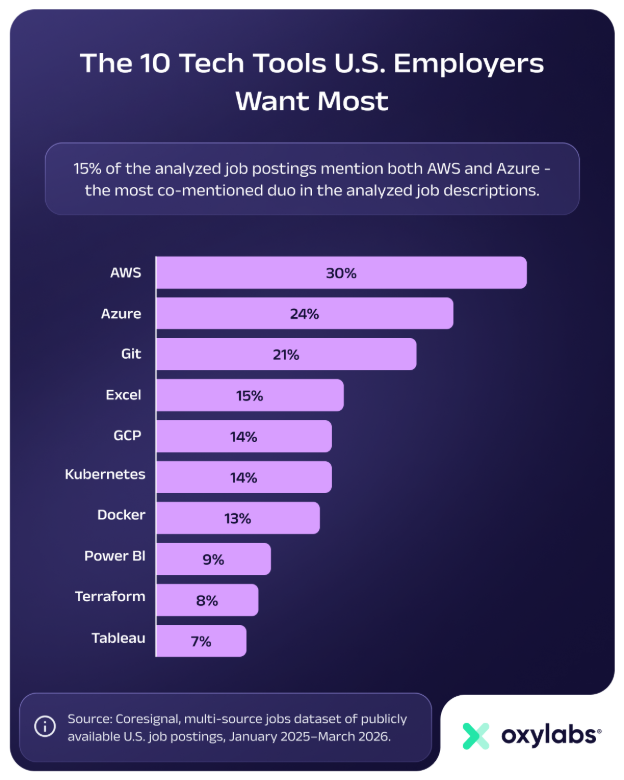
The data shows that nearly 42% of all evaluated job advertisements mandated proficiency in at least one primary cloud infrastructure. Furthermore, Amazon Web Services (AWS) and Microsoft Azure frequently overlap, appearing together as a requested pair in 15% of all job descriptions.
According to the report, employer demand leans heavily toward infrastructure management. Cloud platforms led the breakdown by making up 47% of all tool mentions, with DevOps technologies securing the second spot at 30%, and business intelligence applications rounding out the list at 18%.
“The picture we saw after analyzing close to a million job postings largely confirms what experienced developers would guess – cloud, infrastructure, and data skills are in high demand. Where it gets more interesting is in the proportions: cloud platforms and DevOps tooling dominate job ads even more heavily than survey-based rankings suggest, while some high-visibility skills (the ones trending on X or headlining conference talks) appear less often than you might think,” said Andrius Kūkšta, Tech Lead at Oxylabs.
Core Systems Outpace the Social Media Hype
Even with persistent layoffs across the tech sector, recruitment efforts surged at the start of the year. The opening quarter of 2026 alone generated 39% of the entire dataset’s job listings, representing a 3.7-fold increase in hiring activity compared to the identical timeframe from the previous year.
In terms of specific job categories, software engineering roles led the pack by capturing 38% of total job ads. Data science and AI/ML positions came in next at 14%, matching the 14% share held by tech and engineering management roles, while DevOps and cloud specialties made up 12% of the listings.
The breakdown of tool requirements across different roles reveals that employers are heavily focused on infrastructure and systems deployment. Rather than being universally demanded, advanced data and analytics skills are concentrated within smaller, specialized pockets of the industry.
Across the five comprehensive tool categories evaluated, Data Storage and Infrastructure utilities—chiefly cloud ecosystems like AWS, Azure, and GCP—comprised 47% of all recorded software mentions. Meanwhile, DevOps and Developer Experience tools, anchored by Git and encompassing Docker, Kubernetes, and Terraform, secured a 30% share.
Looking at the rest of the breakdown, Business Intelligence and Analytics software (Power BI, Tableau, and Looker) held an 18% share of employer demand. Farther down the list, Data Ingestion and Transformation utilities—such as dbt, Fivetran, Kafka, and Airbyte—registered at just 4%, while Orchestration and Observability tools like Airflow rounded out the bottom at 1%.
“Chasing the most ‘advanced’ or talked-about tools without building cloud fundamentals first is a risky strategy. The data suggests professionals should first identify their target role category, then master the toolset specific to that path,” – Kūkšta.
Geographic Trends and Market-Specific Requirements
Geographically, California topped total hiring volume at 13%, with Texas trailing at 8% and New York at 5%. But the real standout was Virginia, which posted nearly three times more tech jobs per capita than the U.S. average, thanks to its booming infrastructure of data centers serving major cloud networks.
Although Amazon Web Services (AWS) secured the top spot as the most requested cloud platform across most regions, Microsoft Azure emerged as the frontrunner within a specific group of Southern and Upper Midwest states—such as Minnesota, Indiana, and Tennessee. This local dominance mirrors long-standing enterprise relationships within regional manufacturing and healthcare sectors.
Beyond the core technology sector—which produced 45% of the total job postings—professional services drove 17% of overall hiring demand, while finance and manufacturing each contributed 8%. Additionally, the media and entertainment industry showed notable recruitment activity for cloud-native professionals, heavily leveraging AWS and Git architectures to support digital production workflows.