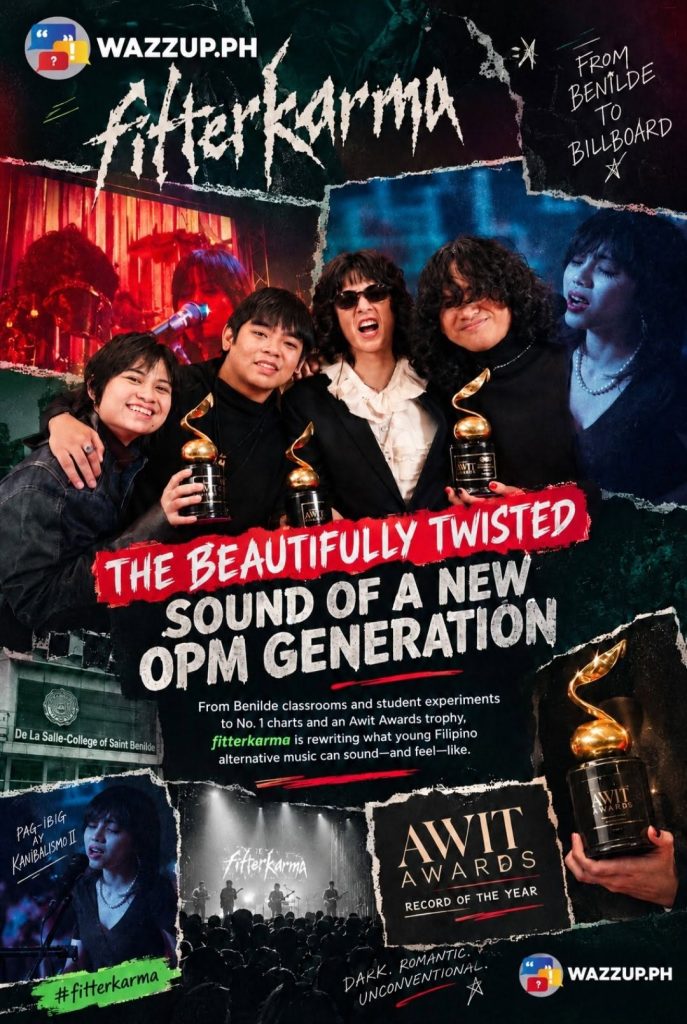
From Benilde classrooms and student experiments to No. 1 charts and an Awit Awards trophy, fitterkarma is rewriting what young Filipino alternative music can sound—and feel—like.
There are bands that make music.
And then there are bands that create an entire universe around it.
fitterkarma belongs to the second kind.
Darkly romantic. Playfully disturbing. Unapologetically unconventional.
Their music doesn’t simply ask you to listen. It invites you into a strange, beautiful world where love can be obsessive, affection can become frightening, and heartbreak can take the form of something almost mythical.
It is a world that began, surprisingly enough, in the halls of De La Salle–College of Saint Benilde.
What started as a student-driven musical project eventually evolved into one of the most intriguing young names in today’s Philippine alternative scene.
And now, fitterkarma has something tangible to show for the journey:
an Awit Award.
FROM BENILDE TO THE BIG STAGE
Before the charts, before the awards, before millions of streams, there were students making music.
fitterkarma’s origins are closely connected to Benilde’s Music Production community. Founder and frontman Joao de Leon initially developed the project as a solo endeavor before it evolved into the band that audiences know today.
The present lineup brings together de Leon on vocals and guitar, Sophia “Soph” Miranda on bass and backing vocals, Sanders Bayas on drums, and Mikee Mendoza, a.k.a. LORY, on guitar.
Their educational background wasn’t simply a footnote in their story.
It became part of the creative DNA that allowed the band to experiment, take risks and resist the pressure to sound like everyone else.
Even the band’s name carries a musical Easter egg: fitterkarma draws inspiration from Radiohead’s “Fitter Happier” and “Karma Police.”
The name already sounded like a warning.
The music made good on it.
WHEN LOVE BECOMES CANNIBALISM
Then came the song that changed everything.
“Pag-Ibig ay Kanibalismo II.”
The title alone sounds like a contradiction—love and cannibalism occupying the same sentence.
But that contradiction is precisely where fitterkarma thrives.
Released on Valentine’s Day in 2025, the track began as something far more intimate than a potential chart-topping record. It was connected to Joao de Leon’s academic and creative work, with the band initially sharing the music without expectations of what would happen next.
Then listeners discovered it.
Then social media discovered it.
Memes helped propel it beyond the band’s existing audience.
Streaming numbers grew.
And suddenly, an experimental alternative track born from a young artist’s creative world was no longer just a song for friends and fellow musicians.
It was becoming a phenomenon.
The track eventually reached No. 1 on the Billboard Philippines Hot 100 and the Top Philippine Songs chart, placing fitterkarma firmly on the national music map.
NOT JUST A VIRAL MOMENT
For any emerging artist, going viral can be a blessing—and a challenge.
The question becomes: What happens after the viral song?
fitterkarma’s answer was simple:
Keep making music.
Songs such as “Kalapastangan” demonstrated that the band’s appeal wasn’t limited to one unusual title or one social-media moment.
Their songwriting continued to push against conventional structures and expectations.
Instead of treating alternative music as a fixed formula, fitterkarma approaches it more like an open canvas.
Rock can coexist with theatricality.
Romance can meet horror.
Folklore can collide with contemporary Manila.
And a song doesn’t necessarily have to behave like a conventional pop song.
That creative freedom is perhaps one of fitterkarma’s most recognizable signatures.
AN OPM UNIVERSE OF HORROR, LOVE AND MYTH
There is a reason the band’s aesthetic feels so distinct.
fitterkarma isn’t simply writing about love.
They’re exploring what love can become when stripped of its usual romantic packaging.
Obsession.
Possession.
Desire.
Fear.
Vulnerability.
The band’s fascination with horror and Filipino folklore gives those emotions another language.
Their music can feel like a love song heard from inside a haunted house.
And somehow, that darkness becomes strangely beautiful.
Their collaboration with Kai Sevillano of Novocrane on “Aswang sa Maynila” further demonstrated their willingness to explore Filipino mythology and contemporary alternative music together.
The result is an artistic identity that feels unmistakably local while remaining contemporary.
THE ALBUM ERA
By 2026, fitterkarma was ready to move beyond individual singles.
Their debut full-length album arrived on September 9, 2026, expanding their musical universe across 13 tracks.
Among the songs are “Purgatoryo,” “666,” and “Bampira”—titles that immediately signal the band’s continuing fascination with darkness, mythology, romance and the supernatural.
But this isn’t simply darkness for darkness’ sake.
Behind the imagery are questions about human relationships and the emotions that make people vulnerable.
That is where fitterkarma finds its particular magic.
The band takes feelings that are difficult to explain and turns them into something you can hear.
AND THEN… THE AWIT AWARDS
On September 15, 2026, the story reached another extraordinary milestone.
At the 39th Awit Awards, fitterkarma took home Record of the Year for “Pag-Ibig ay Kanibalismo II.”
For a young band whose story began in a school environment, the symbolism is hard to miss.
A project that began with students creating music had traveled from classrooms to independent performances, from social media to national charts—and finally to one of Philippine music’s major award ceremonies.
The trophy represents recognition.
But perhaps more importantly, it represents distance traveled.
THE NEXT CHAPTER
And fitterkarma isn’t slowing down.
The band is set to headline its first major concert, “kung tayo’y nasa isang horror na pelikula, tiyak ako ang una mong papatayin: The Album Concert,” at the Metropolitan Theater Manila on September 19, 2026.
The title itself is pure fitterkarma: dramatic, darkly humorous, cinematic and just a little unsettling.
The concert also promises another dimension to the band’s music through its collaboration with The Manila String Machine.
It is another sign that the band is not interested in simply recreating what it has already done.
THE FUTURE IS FITTERKARMA
There is something particularly exciting about watching an artist at the moment when a cult following begins turning into a mainstream audience.
fitterkarma is standing precisely at that intersection.
They have the internet.
They have the charts.
They have the award.
They have the album.
But more importantly, they have an identity.
In an OPM landscape filled with artists searching for the next sound, fitterkarma seems more interested in building its own.
Perhaps that is why their music resonates.
It doesn’t ask permission to be strange.
It doesn’t apologize for being dark.
It doesn’t try to make unconventional ideas comfortable.
Instead, fitterkarma takes the messy, obsessive and sometimes frightening sides of love—and turns them into art.
From Benilde to Billboard.
From student project to national charts.
From “Pag-Ibig ay Kanibalismo II” to an Awit Award.
The story of fitterkarma is still being written.
And if their music is any indication, the next chapter is probably going to be beautifully twisted.