DESIGNING FOR THE PLURIVERSE: WHEN DESIGN BECOMES A CONVERSATION ABOUT PEOPLE, CULTURE AND PLACE
At the 2026 International Design Conference, Grace Nono and fellow thinkers invite audiences to look beyond a single way of knowing—and imagine futures shaped by many voices
MANILA — What if there is no single way to design the future?
What if the places we build, the systems we create and even the solutions we call “innovative” should begin not with a ready-made answer, but with listening—to people, to communities, to culture, to history and even to the natural world around us?
These questions took center stage at the International Design Conference 2026, held September 18 at Foro de Intramuros, Manila, under the evocative theme “Designing for the Pluriverse.”
Organized by the Design Center of the Philippines, the conference brought together designers, cultural practitioners, academics, innovators and community-oriented thinkers for a conversation that stretched far beyond conventional notions of design.
It was a conversation about how we imagine the world—and whose voices are heard when we do.
—
BEYOND ONE VERSION OF THE WORLD
The word pluriverse became the heart of the conference.
Rather than imagining one universal model of progress, the concept recognizes that different communities can have different ways of understanding life, identity, knowledge, nature and development.
In the Philippine context, the idea takes on particular resonance.
The country is an archipelago of thousands of islands, each carrying its own histories, traditions, languages, practices and relationships with place.
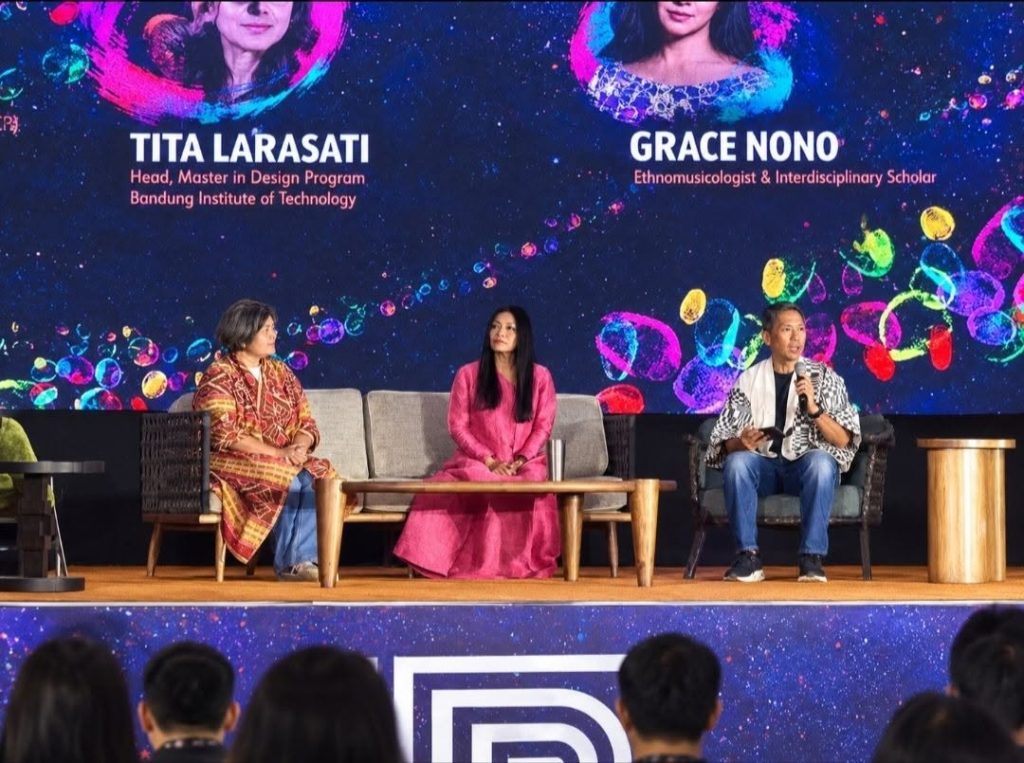
The conference’s “Lessons from the Archipelago” session brought that perspective to the forefront, featuring Indonesian designer Tita Larasati and Filipino ethnomusicologist and interdisciplinary scholar Grace Nono.
Nono’s participation was particularly significant in a conference exploring the relationship between design, culture and different systems of knowledge.
Her work has long engaged with Philippine music, cultural traditions and ways of understanding knowledge beyond conventional academic frameworks.
On the conference stage, the archipelago was more than geography.
It became a way of thinking.
Different islands. Different communities. Different experiences.
Connected—but not necessarily identical.
—
GRACE NONO AND THE POWER OF LISTENING
For many audiences, the presence of Grace Nono in a design conference might initially seem unexpected.
But perhaps that is precisely the point.
If design is about shaping human environments and experiences, then understanding how communities make meaning of their surroundings becomes essential.
Nono’s scholarship provides a bridge between cultural knowledge and contemporary conversations about identity, community and the environment.
The official conference framing of her keynote emphasized multiple ways of being, knowing and belonging, challenging the assumption that progress must always mean moving toward one standardized model.
That perspective invites a different question:
What happens when communities are not simply recipients of designed solutions, but become participants in determining what those solutions should be?
That question sits at the heart of designing for the pluriverse.
—
FROM THE ARCHIPELAGO TO THE WORLD
The conference’s visual language itself reflected its message.
Against a deep, cosmic backdrop, colorful forms appeared to move and overlap—separate shapes existing together without losing their individuality.
It was an appropriate metaphor for the conference.
The pluriverse does not necessarily demand that differences disappear.
Instead, it asks whether different perspectives can coexist, interact and contribute to a shared future.
This became particularly visible during the discussions surrounding voice, agency and authenticity.
Design, in this framework, is not merely about making something beautiful or functional.
It can also be about asking:
Who has a voice?
Who gets to decide?
Whose knowledge is recognized?
Whose experience is missing from the table?
And perhaps most importantly:
Who is the design actually for?
—
DESIGNING WITH PEOPLE, NOT JUST FOR PEOPLE
One of the strongest ideas emerging from IDC 2026 was the distinction between designing for communities and designing with them.
Traditional approaches can sometimes begin with an institution, organization or designer identifying a problem and developing a solution.
The pluriversal approach asks communities to become part of the process itself.
Their knowledge matters.
Their lived experiences matter.
Their culture matters.
Their relationship with their environment matters.
This approach was reflected in the conference’s “Design Labs: Archipelago Activations” and the succeeding sessions on collective agency.
Here, design becomes less about imposing an answer and more about creating a space where different answers can emerge.
—
A DIFFERENT KIND OF INNOVATION
Innovation is often associated with technology, new products or groundbreaking ideas.
But IDC 2026 offered another way of looking at it.
Sometimes, innovation can begin with something much simpler:
listening.
Listening to a community that has been overlooked.
Listening to indigenous knowledge.
Listening to cultural traditions.
Listening to the environment.
Listening to people whose experiences may not fit the dominant narrative.
In that sense, designing for the pluriverse is not necessarily about creating something entirely new.
It can also mean recognizing the value of knowledge and practices that have existed long before the latest technological trend.
—
“MORE THAN ONE WAY TO UNDERSTAND THE WORLD”
Design Center of the Philippines Executive Director Rhea Matute captured the central challenge of the conference in a question:
“What becomes possible when we recognize that there is more than one way to understand the world, and more than one way to design its future?”
It is a question that reaches far beyond the design industry.
It can be applied to cities.
To schools.
To communities.
To public spaces.
To culture.
To business.
To government.
And to the everyday decisions that determine how people live together.
—
THE PHILIPPINE ARCHIPELAGO AS A DESIGN LESSON
Perhaps one of the most powerful ideas of IDC 2026 is that the Philippines does not need to look far for an example of plurality.
We live in it.
From Luzon to the Visayas and Mindanao, communities carry different traditions, languages, practices and relationships with their surroundings.
The challenge is not necessarily to make all of them the same.
The challenge is to find ways for these differences to participate in a common future without erasing what makes each community distinct.
That is where the idea of the pluriverse becomes particularly relevant.
—
THE FUTURE MAY NOT HAVE TO LOOK THE SAME FOR EVERYONE
At the end of the day, Designing for the Pluriverse is not simply a theme for a design conference.
It is a proposition.
Perhaps the future should not be designed as one finished blueprint.
Perhaps it should be continuously shaped by the people who will actually live in it.
And perhaps good design is not always about having the cleverest answer.
Sometimes, it begins with having the humility to ask the right question—and enough openness to listen to the many answers.
From the archipelago, that message carries a distinctly Filipino resonance:
Many islands. Many stories. Many ways of knowing. One shared space to imagine what comes next.
See less