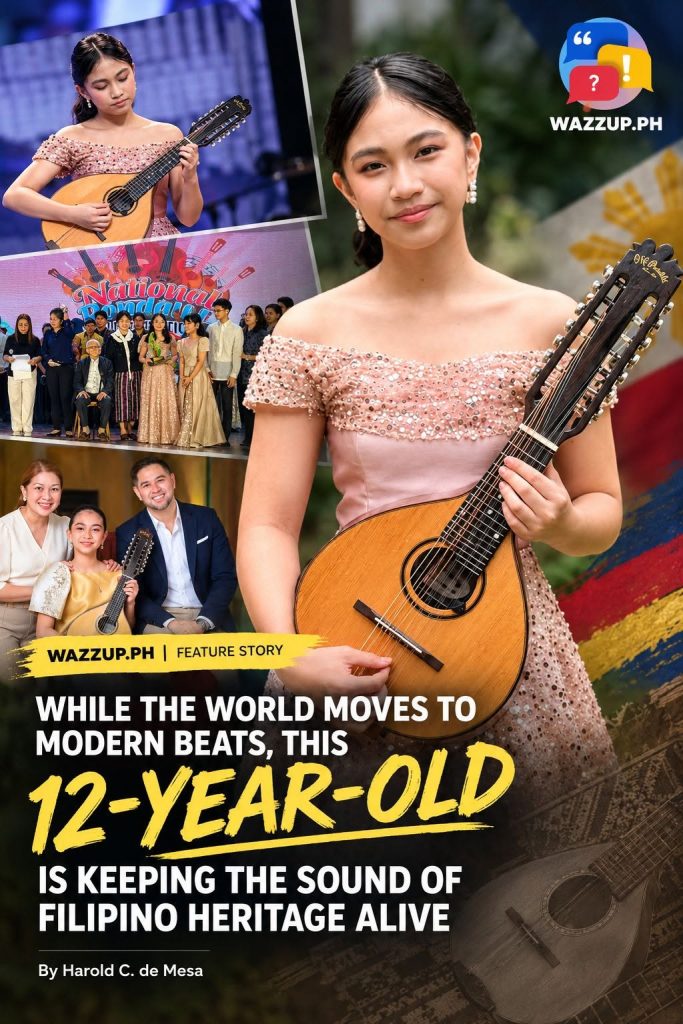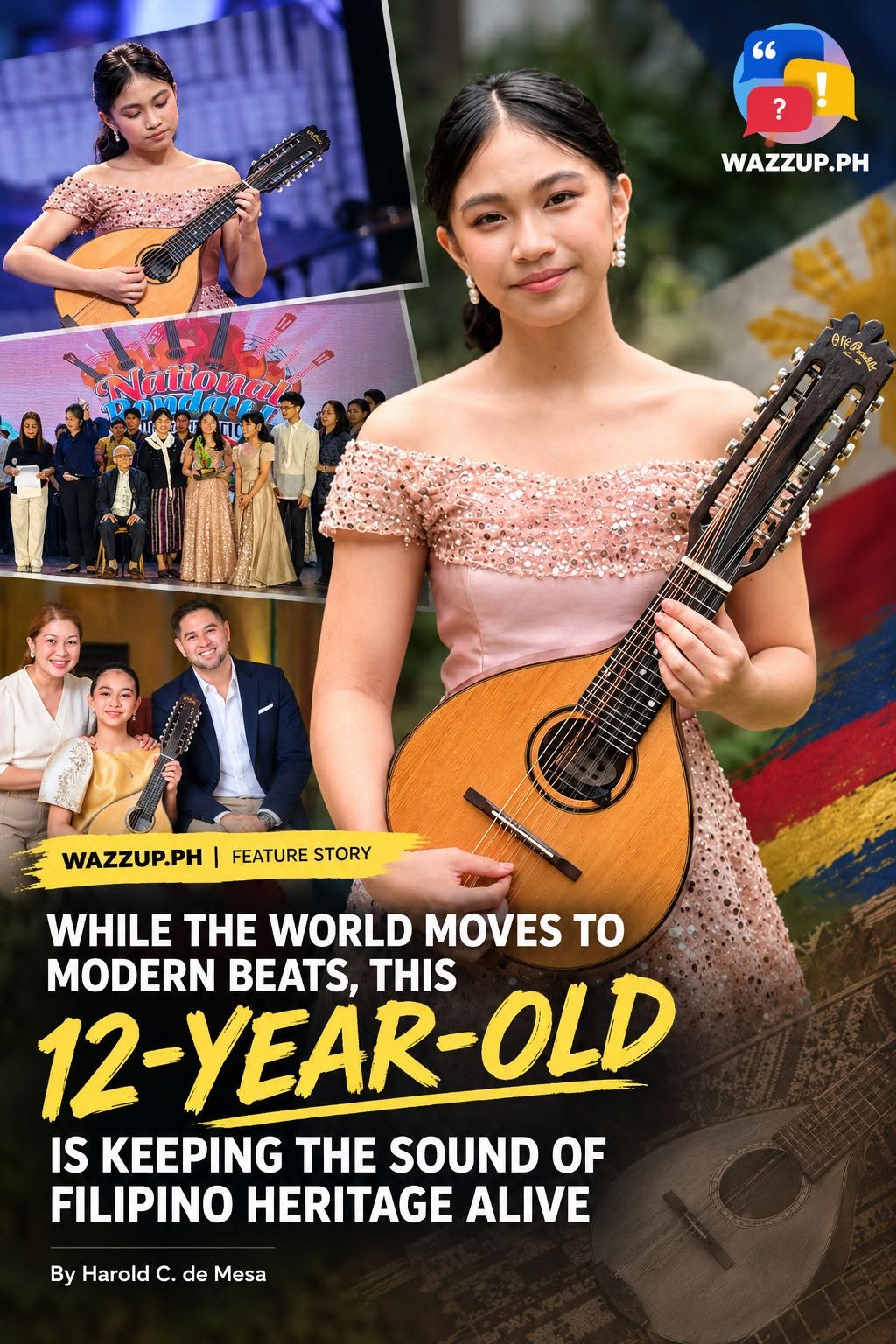
In a generation surrounded by digital playlists, global pop sensations, and ever-changing musical trends, 12-year-old Soleil Amelie Dizon Garcia is pursuing a different sound—one rooted in the melodies and traditions of Filipino Rondalla.
Armed with her bandurria, the young Muntinlupeña is building a musical journey that has brought her national championship titles, international performances, and opportunities to learn from accomplished musicians. Her achievements include winning the National Rondalla Competition in Tagum, Davao, in both 2025 and 2026, becoming a national finalist in the National Music Competitions for Young Artists (NAMCYA), and performing at cultural events that celebrate Philippine music.
From the De La Salle Santiago Zobel (DLSZ) Rondalla to the historic Goldenberg Mansion in Malacañang, Soleil has experienced stages that many young musicians can only hope to reach. She has also performed internationally with the DLSZ Rondalla and appeared as a guest performer at the National Music Summit in Dumaguete, where she performed alongside Filipino musician Joey Ayala.
Yet beyond the titles, venues, and performances lies a story about something more enduring: a young Filipino discovering the value of cultural heritage and choosing to carry it forward through music.
At an age when many children are still exploring their interests, Soleil is developing a deeper relationship with an instrument that has long been part of the country’s musical landscape. Her journey demonstrates that traditional music can continue to find a place in contemporary life when young people are given the opportunity to learn, perform, and share it with others.
A LOVE FOR MUSIC THAT BEGAN IN CHILDHOOD
Soleil’s musical journey began long before she picked up the bandurria.
According to her personal profile, she started her early musical education through KinderMusik at just six months old. At three, she began formal voice lessons, followed by her first recital at four.
A significant turning point came when she joined the DLSZ Rondalla at eight years old. It was there that she first encountered the bandurria, a plucked-string instrument whose bright, resonant sound is central to traditional Filipino Rondalla ensembles.
The instrument would eventually become the defining feature of her musical journey.
Learning the bandurria requires precision, rhythmic discipline, attentive listening, and hours of practice. Each performance demands more than memorizing notes; the musician must understand phrasing, timing, dynamics, and the relationship between individual parts and the ensemble as a whole.
For Soleil, the experience also offered an introduction to a cultural tradition passed from one generation of musicians to another.
Rondalla ensembles typically feature plucked-string instruments such as the bandurria, laud, octavina, and guitar. Their collective sound has become an enduring part of Philippine musical expression, heard in concerts, schools, cultural programs, and community performances.
Although musical tastes continue to evolve, traditional instruments remain relevant when musicians find ways to bring their sound to new audiences.
Soleil’s decision to pursue the bandurria reflects that continuing connection between heritage and the younger generation.
FROM SCHOOL RONDALLA TO THE INTERNATIONAL STAGE
As Soleil developed her skills, her musical abilities were recognized by her coach, Philip Dagang, according to her personal profile.
While still in Grade 4, she was placed in the DLSZ Elite Rondalla, giving her the opportunity to perform alongside high school students. She eventually became one of the ensemble’s soloists.
Performing with older musicians provided a more demanding environment in which she could strengthen her technique, improve her musical interpretation, and learn from experienced performers.
One of her memorable experiences came in 2024, when the DLSZ Rondalla participated in the World Projects “Sounds of Summer” Music Festival, held June 7–11.
According to the information supplied for this feature, the ensemble received a Gold Award and performed at Walt Disney Concert Hall in Los Angeles, California.
The international experience also included a special milestone for Soleil: her first solo performance at Disneyland, where she performed the solo part in Johann Pachelbel’s Canon in D.
For a young bandurria player, a solo performance presents a different challenge from playing as part of an ensemble. It requires individual concentration, confidence, and musical expression while maintaining coordination with the other performers.
International appearances can also expose young musicians to new audiences and performance environments. Behind the experience are the rehearsals, corrections, preparation, and teamwork required to deliver a successful performance.
For Soleil, these opportunities became part of a broader musical education—one that extends beyond the classroom and the competition stage.
They also demonstrated that an instrument associated with Filipino musical heritage can find an audience in international settings.
LEARNING FROM THE MASTERS OF RONDALLA
Another important chapter in Soleil’s development has been her association with the Celso Espejo Rondalla.
In her personal profile, she describes becoming the ensemble’s youngest member and soloist as one of the greatest milestones of her musical life.
The group was founded by Maestro Celso Espejo, whom her profile identifies as the Father of Modern Rondalla. Soleil also expresses gratitude for the opportunity to have been his last student, an experience she considers a privilege in her musical education.
She continues to develop as a bandurria soloist under the guidance of Professor Elaine Juliet Espejo, whom her profile identifies as a leading bandurria player in the country.
Mentorship is especially important in traditional music, where technique and interpretation are developed through sustained instruction and practice. Beyond teaching notes and musical passages, experienced musicians help students understand style, discipline, and the cultural context of the pieces they perform.
For a young musician, learning from accomplished practitioners can provide a foundation that extends well beyond individual competitions.
The relationship between teacher and student also plays a role in preserving cultural knowledge. Music survives not only through recordings and written compositions but through people who continue to perform, teach, and interpret it.
In this respect, Soleil’s training represents more than personal advancement. It is part of a continuing exchange between generations of Filipino musicians.
TWO NATIONAL CHAMPIONSHIP TITLES AT 12
Soleil’s dedication to Rondalla has translated into significant competitive achievements.
She won the National Rondalla Competition in Tagum, Davao, in both 2025 and 2026, according to the information provided for this feature. The back-to-back titles mark important milestones in her development as a young musician.
Her record also includes national finalist placements in the National Music Competitions for Young Artists.
In 2025, she reached the finals in the Children’s Solo Category. In 2026, she became a national finalist in the Junior Solo Rondalla category.
These achievements reflect her continued participation in national-level musical competitions and her willingness to take on increasingly demanding challenges.
Competitions test more than technical proficiency. Musicians must interpret their repertoire, maintain composure under pressure, and demonstrate the discipline required to prepare for performances judged against established standards.
For young artists, these experiences can also provide valuable opportunities to learn from fellow performers, receive feedback, and identify areas for improvement.
Titles and finalist placements are meaningful milestones, but they are not the end of a musician’s development. Each competition brings new lessons, and each new piece presents another opportunity to improve.
For Soleil, the challenge is to build on her accomplishments while remaining open to learning.
Her achievements also draw attention to Rondalla as a living musical tradition—one that continues to attract young performers willing to devote time and effort to mastering its instruments.
A YOUNG MUNTINLUPEÑA ON THE NATIONAL MUSIC MAP
One of the significant milestones in Soleil’s journey was her qualification for the 53rd National Music Competitions for Young Artists through the Padayaw Manila Regional Semifinals.
In a congratulatory announcement, the Muntinlupa Tourism, Culture, and the Arts Department (MTCAD) recognized her as the youngest national qualifier in the NCR Cluster.
The recognition highlighted the progress of a young musician from Muntinlupa whose musical development has involved years of training, ensemble performances, and competition experience.
Qualifying for a national competition provides an opportunity to perform in a more demanding setting and encounter other musicians pursuing excellence in their respective fields.
For Soleil, the qualification forms part of a journey that began in early childhood and continues to evolve through training and performance.
It also gives her an opportunity to represent her city in a national musical setting.
Muntinlupa’s emerging artists deserve recognition not only for their awards but also for the commitment required to develop their craft. Their stories demonstrate the value of providing young people with access to cultural education, qualified mentors, instruments, and venues where they can share their abilities.
Soleil’s experience illustrates how an early interest in music can grow into a serious pursuit when supported by consistent instruction and opportunities to perform.
FROM MUNTINLUPA TO MALACAÑANG
Another memorable experience came when Soleil performed at the Goldenberg Student Recital Series at the historic Goldenberg Mansion in Malacañang.
In a message of gratitude, she described the performance as an important milestone in her musical journey. She thanked the Office of the President Social Secretary’s Office for the invitation and acknowledged the support of her family, friends, and team.
Performing at a historic venue offered another opportunity to share her musical abilities with an audience beyond her home city.
For a young performer, such an invitation can be both an honor and a learning experience. It calls for preparation, confidence, and the ability to deliver a performance in a setting that may differ from familiar concert halls or school venues.
But the value of a performance cannot be measured by the prestige of the venue alone. Each opportunity to perform allows a musician to develop stage presence, manage expectations, and gain experience in presenting music before different audiences.
Soleil’s reflections also reveal an appreciation for the people who have helped make these opportunities possible.
Behind a young musician’s public achievements are family members, teachers, coaches, and fellow performers who provide encouragement and guidance through the demanding process of preparation.
Her journey underscores the importance of that support network in helping young artists develop their abilities and confidence.
SHARING THE STAGE WITH JOEY AYALA
Soleil’s musical experiences have also brought her to Dumaguete, where she performed at the National Music Summit and shared the stage with Joey Ayala, a respected Filipino musician known for incorporating indigenous and traditional musical influences into contemporary expression.
Her participation placed the young bandurria player in a broader setting dedicated to Philippine music and its continuing development.
For a young performer, opportunities to encounter established musicians can expand one’s understanding of what music can accomplish. They can demonstrate how cultural influences, traditional instruments, and contemporary approaches can coexist without losing their distinctive identities.
Soleil has also described her participation in musical gatherings as an opportunity to meet people who share her appreciation for Filipino music.
Her experiences in Dumaguete included spending time with family, discovering local culture, and making memories beyond the performance itself.
These moments offer a reminder that musical education does not happen exclusively during rehearsals or competitions. Travel, collaboration, and encounters with other performers can also shape a young musician’s perspective.
In competitive environments, Soleil has expressed gratitude for fellow performers who helped her remain calm and encouraged her along the way.
Their support illustrates how music can foster relationships and shared experiences even among people pursuing individual goals.
The performance alongside Ayala adds another dimension to her journey: a young musician learning to participate in a larger cultural conversation while continuing to develop her own abilities.
THE DISCIPLINE BEHIND EVERY NOTE
For a Grade 7 student, pursuing music alongside academic responsibilities requires commitment and balance.
Practice takes time. Performances demand preparation. Competitions require concentration and discipline. At the same time, young musicians need room for school, family, friendships, rest, and the ordinary experiences of growing up.
Soleil’s journey highlights the importance of nurturing talent without losing sight of the young person behind the achievements.
Family encouragement, guidance from mentors, and access to opportunities can help children develop not only their musical abilities but also their patience, confidence, and sense of responsibility.
Soleil has acknowledged the contributions of her family, friends, coaches, fellow performers, and the institutions that have welcomed her talent.
Her gratitude reflects an important reality: although a performance may place one musician in the spotlight, the journey toward that moment often involves many people working behind the scenes.
Continued growth also requires humility—the willingness to accept constructive criticism, learn from mistakes, and return to practice even when progress takes time.
For Soleil, each performance offers another opportunity to apply those lessons and deepen her understanding of the bandurria.
KEEPING FILIPINO MUSIC ALIVE IN A CHANGING WORLD
In a musical landscape shaped by streaming platforms, viral trends, and rapidly changing tastes, traditional Filipino music faces the continuing challenge of reaching younger audiences.
That challenge does not mean traditional music must compete with modern genres on their own terms. Rather, it calls for opportunities that allow young people to encounter, understand, and appreciate the country’s musical heritage.
Rondalla remains a meaningful part of that heritage. Its instruments, repertoire, and ensemble traditions connect performers to generations of musicians who have kept the form alive through teaching and performance.
Soleil has expressed the hope that her experiences will encourage more young Muntinlupeños to embrace Rondalla and explore its instruments.
Her message is simple: cultural heritage remains alive when the next generation chooses to participate in it.
Preservation cannot depend on nostalgia alone. Music must continue to be played, taught, heard, and experienced. Young musicians need opportunities to study traditional instruments, perform before audiences, and encounter mentors who can help them develop their abilities.
Schools, cultural institutions, local governments, arts organizations, families, and communities all have a role in creating those opportunities.
Recognition can inspire young performers, but sustained support is equally important. Access to instruments, qualified instruction, rehearsal spaces, scholarships where available, and regular performance opportunities can help transform an early interest into a lasting musical commitment.
Through her work with the bandurria, Soleil offers a glimpse of what that future might look like: a young Filipino learning from established musicians while introducing a traditional instrument to audiences who may be discovering its sound for the first time.
Her journey demonstrates that preserving heritage does not require turning away from the present. It requires finding ways for the music of the past to remain meaningful in the lives of people today.
A CITY’S PRIDE, A CULTURAL TRADITION’S FUTURE
Soleil’s achievements provide Muntinlupa with another young artist whose work connects local pride with a broader Filipino cultural identity.
Her experience also raises an important question: How can communities continue supporting young musicians long after their first awards, recitals, or public appearances?
The answer lies in sustained opportunities to learn and perform, as well as in recognizing that cultural development requires more than occasional ceremonies or congratulatory announcements.
Young musicians need environments where they can improve their technique, explore repertoire, collaborate with others, and encounter audiences who appreciate their work.
For Muntinlupa, supporting artists such as Soleil means investing in a cultural community that can grow across generations.
Their achievements deserve celebration, but so does the process behind them: the hours of practice, the guidance of mentors, the encouragement of families, and the determination to continue learning.
Every young musician who discovers the value of a traditional instrument represents another opportunity for Filipino music to find a new audience.
THE NEXT GENERATION, ONE NOTE AT A TIME
Soleil Amelie Dizon Garcia’s musical journey is still unfolding.
There will be more pieces to master, performances to prepare for, and lessons that will shape her development as both a musician and a young person.
Her national championship titles, NAMCYA finalist placements, international performances, and cultural appearances are milestones worth celebrating. But they are only part of a larger story about dedication, mentorship, and the continuing life of Filipino musical heritage.
At 12, Soleil still has much to learn and many possibilities ahead. What makes her journey meaningful is not simply where she has performed or how many titles she has earned, but the possibility that her commitment to the bandurria will encourage others to discover Rondalla for themselves.
Every generation inherits something from the one before it. In music, that inheritance lives in the melodies passed down, the instruments carefully played, and the traditions kept alive by those willing to learn.
While the world moves to modern beats, the sound of Filipino heritage continues through young musicians who choose to carry it forward.
Soleil is among them.
With every performance, she is helping ensure that the bandurria remains more than an instrument from the past. It remains a living voice in the Philippines’ musical present—and a sound that future generations may continue to hear, learn, and love.
For Soleil, the journey continues one note at a time.