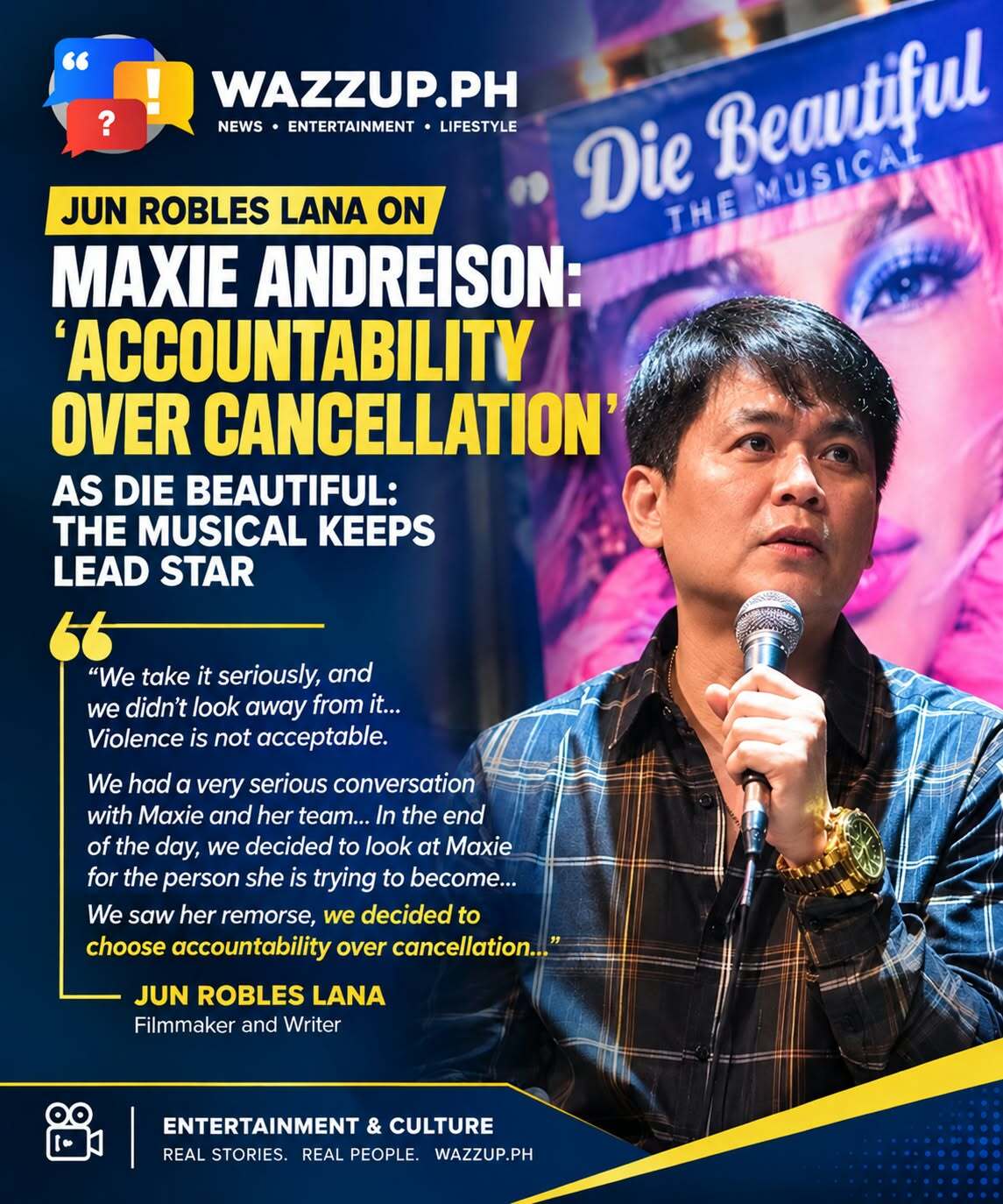
MANILA, Philippines — Filmmaker and writer Jun Robles Lana has defended the decision to retain drag performer Maxie Andreison in the upcoming stage production of Die Beautiful: The Musical, saying the production team chose “accountability over cancellation” after addressing the controversy surrounding the performer.
Speaking at a press conference for IdeaFirst Live’s upcoming theater season, Lana said the production took the matter seriously and held a discussion with Maxie and her team before deciding to keep her in the cast. He stressed that the decision was based on the remorse they observed, while emphasizing that the production would continue to monitor the situation closely.
“Violence is not acceptable,” Lana said, according to published reports. He added that Maxie would be expected to uphold high standards of respect and advocacy as a member of the production.
His remarks have brought renewed attention to a broader question facing the entertainment industry: how should employers, producers and creative institutions respond when a performer faces public criticism over past conduct?
A VIDEO RESURFACES, PROMPTING PUBLIC BACKLASH
The controversy resurfaced in June 2026, when a video from an incident reportedly dating to 2023 circulated online. The footage showed Maxie and another person involved in a physical confrontation with a woman. News reports described the video as showing Maxie slapping and kicking the woman.
The resurfaced footage prompted criticism and calls from some social media users for Maxie to be removed from Die Beautiful: The Musical.
Maxie subsequently addressed the controversy in a public livestream, acknowledging that her actions were wrong and apologizing to the people affected and to supporters who were disappointed.
In statements reported by GMA News and Philstar.com, Maxie said the incident had occurred about three years earlier and that the parties involved had already apologized to one another and moved forward. She also expressed regret, saying she wished she had handled the situation more calmly and wisely.
“Ito ay hindi tama,” was the substance of her acknowledgment: hurting another person was wrong, regardless of the circumstances.
Maxie’s apology is an important part of the public record. However, an apology and a claim that a personal dispute has been resolved do not automatically erase the harm depicted in the footage or settle every question raised by the public.
Reports have also circulated about the circumstances leading to the confrontation, including claims that a fan had pulled Maxie’s wig. Such accounts should be attributed to their sources and should not be presented as independently established facts without further verification. Whatever the circumstances, the reported footage and Maxie’s own acknowledgment that her response was wrong remain central to the controversy.
WHY THE PRODUCTION CHOSE ACCOUNTABILITY
Lana’s position appears to distinguish accountability from permanent professional exclusion.
By retaining Maxie, the production is giving the performer an opportunity to continue her work while setting expectations for her conduct. Lana said the team had taken the controversy seriously, spoken with Maxie and her team, and observed remorse. He also made clear that keeping her in the musical did not mean the issue would simply be ignored.
That distinction matters. Accountability involves more than expressing regret publicly. It may include acknowledging the harm caused, respecting those affected, learning from the incident, demonstrating changed behavior and accepting reasonable standards of conduct.
At the same time, the production’s decision is not proof that every concern has been resolved, nor does it require members of the public to approve of the casting choice.
The company has the responsibility to explain its decision and uphold the standards it says it expects from its performers. Audiences, meanwhile, may assess that decision based on the available facts, the production’s response and Maxie’s conduct going forward.
The public debate therefore extends beyond whether Maxie should be retained or removed. It also concerns what accountability should look like when a person who has acknowledged wrongdoing is given another professional opportunity.
ARTISTIC FREEDOM AND PROFESSIONAL RESPONSIBILITY
Die Beautiful: The Musical adapts the acclaimed 2016 film directed by Lana, which starred Paolo Ballesteros as Trisha Echevarria. Maxie is set to portray Trisha in the stage adaptation, alternating in the role with fellow drag performer Viñas DeLuxe.
The story’s place in Philippine LGBTQIA+ representation adds another dimension to the discussion. The production draws from a film that explored identity, family, discrimination, dignity and acceptance. Its creative team must therefore navigate not only artistic considerations but also the expectations of audiences who attach importance to the values represented by the work.
Still, a production’s themes should not be used to excuse an individual performer’s conduct. Nor should a person’s past mistake automatically be treated as proof that meaningful change is impossible.
The more constructive question is whether the standards being invoked by the production will be reflected in actual conduct, clear expectations and a willingness to respond if further concerns arise.
Lana’s statement that Maxie will be watched closely suggests that the decision to retain her comes with continuing scrutiny rather than unconditional endorsement.
THE ROLE OF SOCIAL MEDIA IN PUBLIC ACCOUNTABILITY
The controversy also illustrates the complicated role of social media in shaping public judgment.
The rapid circulation of old footage can bring attention to conduct that might otherwise remain outside public discussion. It can give affected individuals and concerned audiences a platform to demand answers. But the same speed can also encourage conclusions before the context, identities, chronology and relevant responses have been fully established.
A video can be important evidence of what appears in the recorded moment. It does not necessarily establish every event before or after that moment, the complete circumstances of a confrontation, or the legal consequences of the conduct shown.
Responsible public discussion requires distinguishing what the footage depicts, what the people involved have said, what independent reporting has verified and what remains uncertain.
Calls for accountability should not be dismissed merely because they emerge online. Equally, public criticism should not become an excuse for harassment, threats or the spread of unsupported allegations.
The passage of time is relevant, but it is not by itself proof of rehabilitation. An apology is relevant, but it is not by itself proof of lasting change. Those questions require attention to the person’s subsequent conduct and the credibility of the steps taken to address the incident.
WHAT ACCOUNTABILITY SHOULD MEAN FROM HERE
For IdeaFirst and the creative team, retaining Maxie places greater importance on making their stated standards meaningful. Respect, advocacy and responsibility should be demonstrated, not merely invoked in a press conference.
For Maxie, the challenge is to make the acknowledgment expressed in her apology consistent with her conduct moving forward. Public trust is not restored by a single statement; it develops over time through actions.
For audiences and members of the LGBTQIA+ community, the decision may prompt differing reactions. Some may welcome the opportunity for personal growth, while others may question whether retaining the performer adequately recognizes the seriousness of the incident. Both concerns can be discussed without resorting to personal attacks.
For the media, the obligation is to report the controversy accurately, include the relevant responses, avoid sensationalism and refrain from treating online outrage as a substitute for verification.
Ultimately, “accountability over cancellation” should not mean immunity from criticism or freedom from consequences. Neither should accountability automatically mean permanent exclusion from professional life.
The more meaningful test is whether acknowledgment leads to responsibility, whether expectations are upheld and whether changed conduct can be demonstrated over time.
For Die Beautiful: The Musical, the decision to retain Maxie Andreison has been made. Whether that decision earns public confidence will depend not only on what its creative leaders say today, but also on how they uphold their stated standards of respect, responsibility and advocacy in the months ahead.