On September 12, 2026, at the Plenitude Arena in Nanterre, Paris, the legendary singer opened what was announced as a 26-show residency, transforming an evening of music into something far more intimate: a celebration of survival, style, emotion and the extraordinary power of returning.
Thousands of lights from cellphone screens shimmered across the arena as Dion began with “On Ne Change Pas.”
For a moment, the spectacle gave way to something deeply human.
Dion paused.
Overwhelmed by the audience and the significance of the moment, she reflected on the difficult road that had brought her back to the stage.
“I have to admit, though, that the road was rocky,” she told the crowd.
Then came the words that seemed to illuminate the entire evening:
“And here it is. The sun — the sun is here. The sun, right in front of me.”
And suddenly, Paris was no longer simply watching a concert.
It was watching Céline Dion come home.
THE ART OF RETURNING
There are comebacks.
And then there are returns that feel almost cinematic.
Dion’s absence from the stage followed her public disclosure of Stiff Person Syndrome (SPS), a rare neurological disorder that significantly affected her ability to perform.
Her journey away from the spotlight was marked by uncertainty, physical challenges and an extraordinary period of reinvention.
So when she finally appeared beneath the lights again, the moment carried a significance that no stage production could manufacture.
This was not simply a singer returning to work.
It was an artist reclaiming a part of herself.
And, naturally, she did it in couture.
COUTURE AS ARMOR
For Céline Dion, fashion has never been merely decoration.
Throughout her career, clothing has functioned as performance, personality and spectacle. In Paris, that relationship between fashion and music became even more pronounced.
Her wardrobe told its own story.
Black became strength.
Gold became radiance.
Pink became softness.
Sculptural silhouettes became armor.
And every entrance seemed designed to announce not simply that Dion had returned—but that she had returned on her own terms.
DIOR: THE OPENING STATEMENT
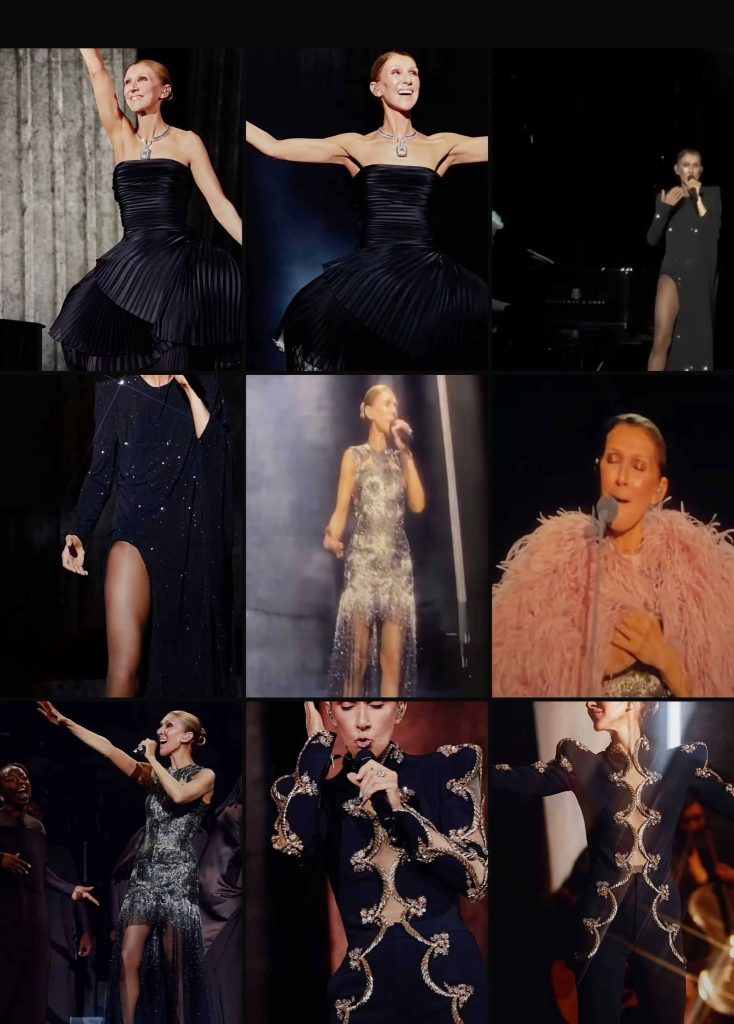
She began in a breathtaking custom Dior gown.
Black, sculptural and unapologetically dramatic, the creation featured glossy pleated details and an asymmetrical, petal-like peplum skirt.
The silhouette reportedly drew inspiration from a 1950 Dior design associated with composer Francis Poulenc, connecting contemporary glamour with the house’s rich history.
Around her neck was another extraordinary piece of artistry: a Boucheron collar crafted in white gold and centered by a spectacular 10-carat emerald-cut diamond.
It was less an outfit than an entrance.
Dion emerged looking every inch the icon the audience had waited to see.
SCHIAPARELLI: THE WARRIOR IN BLACK
Then came Schiaparelli Haute Couture, courtesy of creative director Daniel Roseberry.
A black silk-crepe bodysuit was transformed by pale-gold embroidered cords, crystal floral motifs and mirrored embellishments.
The effect was strikingly sculptural.
There was delicacy in the embroidery, but power in the silhouette.
It felt like couture armor.
And on Dion, the metaphor seemed almost inevitable.
She had spent years away from the stage.
Now she was back—dressed for battle.
GIVENCHY: A DREAM IN PINK
The mood softened with a custom Givenchy ensemble created under Sarah Burton.
A dusty-pink shredded-organza embroidered cape floated over an embroidered cutout dress, creating movement with every step.
Later, Dion appeared in a fuzzy pink feather cape layered over silver, trading dramatic authority for something more ethereal.
The effect was almost dreamlike.
And that was perhaps the beauty of the wardrobe: it allowed Dion to move through different emotional worlds without ever losing the unmistakable presence of the woman at the center of them.
TOM FORD: POWER, REIMAGINED
Then came the sharp geometry of Tom Ford, in a look associated with designer Haider Ackermann.
Dark navy.
Asymmetric construction.
Pronounced power shoulders.
Subtle shimmering details reminiscent of a night sky.
The silhouette was futuristic without feeling cold, powerful without becoming rigid.
It was Dion in another register: sophisticated, commanding and entirely in control of the room.
LOUIS VUITTON: THE SECOND-NIGHT REVEAL
On September 16, Dion continued the fashion narrative in a custom Louis Vuitton creation designed by artistic director Nicolas Ghesquière.
A black satin bustier minidress featured asymmetrical pleating, hip bows and a dramatic one-sided train.
Over it came a structured wool jacket with rounded shoulders.
The result was unmistakably Parisian: polished, architectural and quietly extravagant.
It was the kind of look that did not ask for attention.
It commanded it.
WHEN THE CLOTHES BECOME PART OF THE STORY
Dion has spent decades understanding the power of an unforgettable image.
There was the playful irreverence of her Vetements Titanic hoodie.
There were her countless Paris fashion moments.
And there was the extraordinary Dior creation she wore for the 2024 Paris Olympics Opening Ceremony, a performance that reaffirmed her ability to turn fashion and music into one seamless spectacle.
But Paris in 2026 feels different.
Because this time, the clothes are not simply part of Céline Dion’s image.
They are part of her return.
Every gown, every silhouette, every flash of jewelry seems to frame the same narrative:
She is here.
THE WOMAN BEHIND THE ICON
At 58, Dion stood before thousands of people carrying something no designer could create and no stylist could manufacture—the emotional weight of lived experience.
For years, audiences had known her primarily through recordings, memories and archival performances.
Now they could see her again in real time.
The voice.
The gestures.
The theatricality.
The vulnerability.
The glamour.
The unmistakable Céline.
Her return does not erase the years she spent away from the stage.
It gives those years context.
The silence becomes part of the song.
The absence becomes part of the performance.
And the return becomes something more meaningful than a conventional comeback.
PARIS, CÉLINE AND THE SPOTLIGHT
There was a time when the stage seemed inseparable from Céline Dion.
Then came a period when she had to step away from it.
Now, in Paris, the lights have come back on.
The couture is immaculate.
The arena is electric.
The audience is waiting.
And Céline Dion is standing at the center of it all.
Perhaps that is the real luxury of this moment—not the diamonds, the couture or the grandeur of the production.
It is the privilege of witnessing an artist return to something she loves.
After the silence, there is music.
After the darkness, there is light.
And after years away, Céline Dion is once again exactly where she belongs: beneath the spotlight.
She did not simply come back to sing.
She came back to claim the stage.