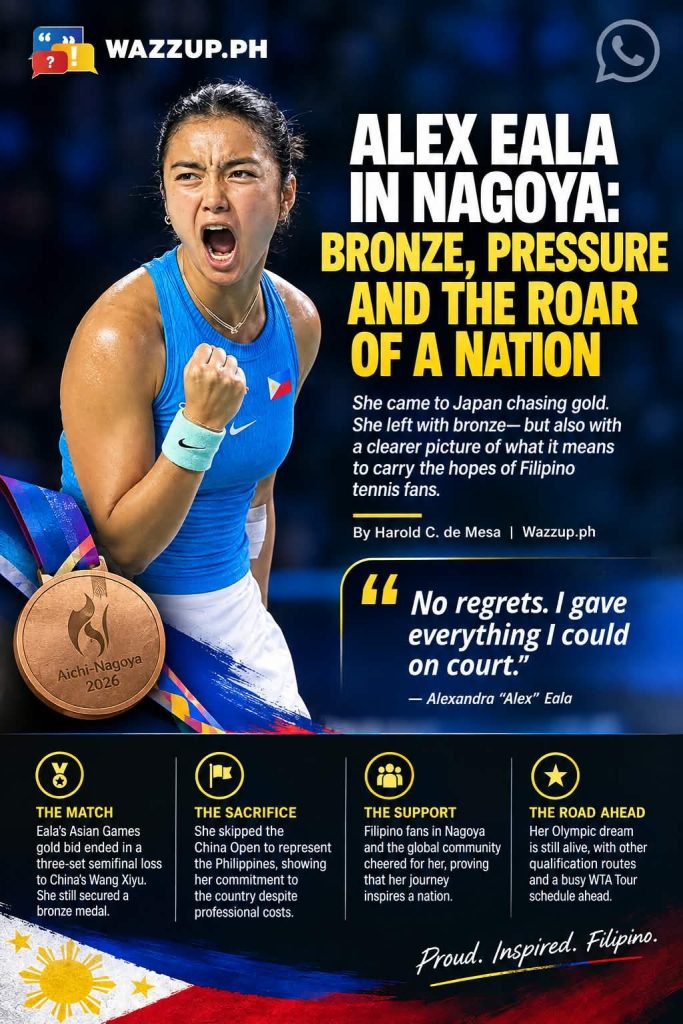
A medal in Nagoya tells only part of the story. Behind it was a choice to play for the Philippines, even at a professional cost.
NAGOYA, JAPAN — The medal is bronze.
But for Alexandra “Alex” Eala, it was never just bronze.
Eala’s Asian Games gold-medal campaign ended in the semifinals after China’s Wang Xiyu rallied to defeat the Philippines’ top seed, 3-6, 6-3, 6-2. The result left Eala with her second consecutive Asian Games singles bronze and her third Asian Games medal overall.
The scoreboard recorded a loss.
The medal table recorded bronze.
But the circumstances surrounding Eala’s decision to compete in Nagoya tell a larger story.
“SHE CHOSE TO PLAY FOR THE FLAG”
A central part of the conversation surrounding Eala’s campaign was her decision to represent the Philippines instead of playing the concurrent China Open in Beijing.
The choice carried professional consequences. Eala gave up the opportunity to earn ranking points and prize money and could face WTA sanctions for missing the mandatory event.
Manny V. Pangilinan, chairman of the MVP Group, highlighted precisely that sacrifice in a message accompanying the image shared in connection with Eala’s bronze-medal campaign:
“Alex chose to play for the flag when she could have played for prize money in Beijing.”
That distinction gives the bronze medal another dimension.
Eala did not simply arrive in Nagoya as a highly ranked professional tennis player. She arrived having made a choice between two significant opportunities: continuing her WTA campaign in Beijing or wearing Philippine colors at the Asian Games.
She chose the flag.
And after the semifinal defeat, Eala said she had no regrets, emphasizing her experience, the support she received and the opportunity to compete for the country.
NOT THE GOLD SHE WANTED
There is no need to disguise the competitive disappointment.
Eala came to Nagoya as the tournament’s top seed and world No. 18, with legitimate hopes of winning the Philippines’ first Asian Games tennis singles gold in decades.
She began her semifinal against Wang strongly, racing to a 5-0 lead and taking the opening set, 6-3.
Wang, ranked No. 85 in the world, changed the momentum in the second set and eventually completed the comeback, 6-3, 6-2.
The defeat also ended Eala’s direct Asian Games route to qualification for the 2028 Los Angeles Olympics.
But it did not end her Olympic dream.
Eala has other qualification pathways available, and her WTA season continues, with the Wuhan Open scheduled to begin October 12.
THE PACQUIAO PARALLEL—WITHOUT ERASING THE DIFFERENCE
The comparison to Manny Pacquiao has surfaced repeatedly as Eala’s international profile has grown.
Eala herself has previously addressed those comparisons, saying that their journeys are very different and that she remains far from Pacquiao’s level of achievement. At the same time, she credited Pacquiao for demonstrating that Filipinos can succeed on the international sporting stage.
That is perhaps where the Pacquiao legacy provides useful context—not as a claim that Eala is the “next Pacquiao,” but as a reminder of what Filipino athletes can represent beyond the scoreboard.
Pacquiao’s career became associated with Filipino identity and national pride. President Ferdinand Marcos Jr., in a February 2026 speech honoring Pacquiao’s memorabilia, likewise described him as a champion not only in boxing but also as a Filipino and a source of pride for Filipinos at home and abroad.
Eala’s story is different.
Her sport is different.
Her generation is different.
Her journey is still being written.
But the common thread is the opportunity for a Filipino athlete competing on the international stage to make people at home feel represented.
BRONZE WITH A BACKSTORY
Eala’s Nagoya campaign was also shaped by the Filipino supporters who followed her.
Her opening match was moved indoors because of weather, turning what was expected to be a large-crowd appearance into a match watched by only a limited number of spectators. Filipino supporters who had traveled to see her were disappointed, but Eala adapted and won her opening match convincingly.
She later defeated Chinese Taipei’s Joanna Garland in the quarterfinals to secure at least a bronze medal.
By then, the medal was already guaranteed.
What remained was the color.
Gold escaped her.
Silver became impossible.
Bronze became certain.
And bronze is still a medal won on behalf of the Philippines.
“NO REGRETS”
After the semifinal, Eala did not reduce the experience to the result.
She spoke about being with the Philippine team, experiencing the support and competing for the country.
“No regrets,” was the message that emerged from her post-match comments.
That matters because the decision to compete in Nagoya had already required a sacrifice.
The medal did not erase the loss.
But the loss did not erase the choice.
And the choice is part of what makes the bronze significant.
BRONZE. BUT NEVER JUST BRONZE.
There will always be a temptation in elite sports to measure everything by gold.
Eala did not win the Asian Games singles title.
That is the fact.
But another fact stands beside it: she chose to represent the Philippines despite the professional opportunity she left behind.
So when the medal is placed around her neck, the bronze tells only one part of the story.
It tells us where she finished.
It does not tell us everything she gave up to be there.
It does not tell us about the Filipino flags in the stands.
It does not tell us about a young athlete carrying expectations from a country watching her every point.
And it does not tell us what comes next.
Bronze, yes.
But never just bronze.
For Alex Eala, Nagoya is another chapter in a career that is still unfolding—and another moment in which a Filipino athlete chose to step onto the international court carrying more than a racket.
She carried the flag.