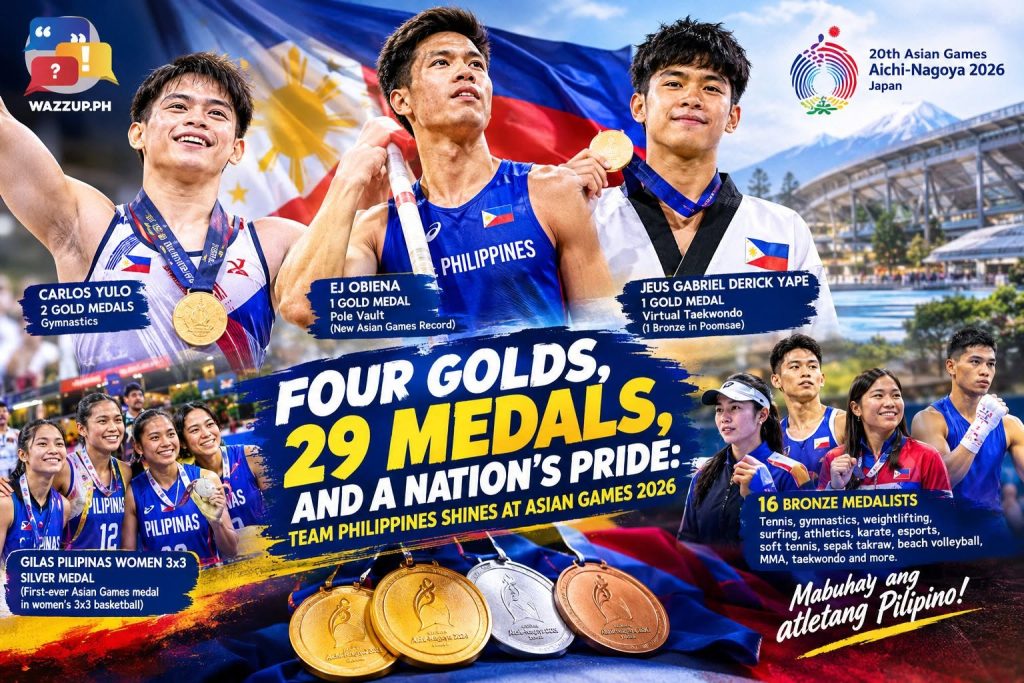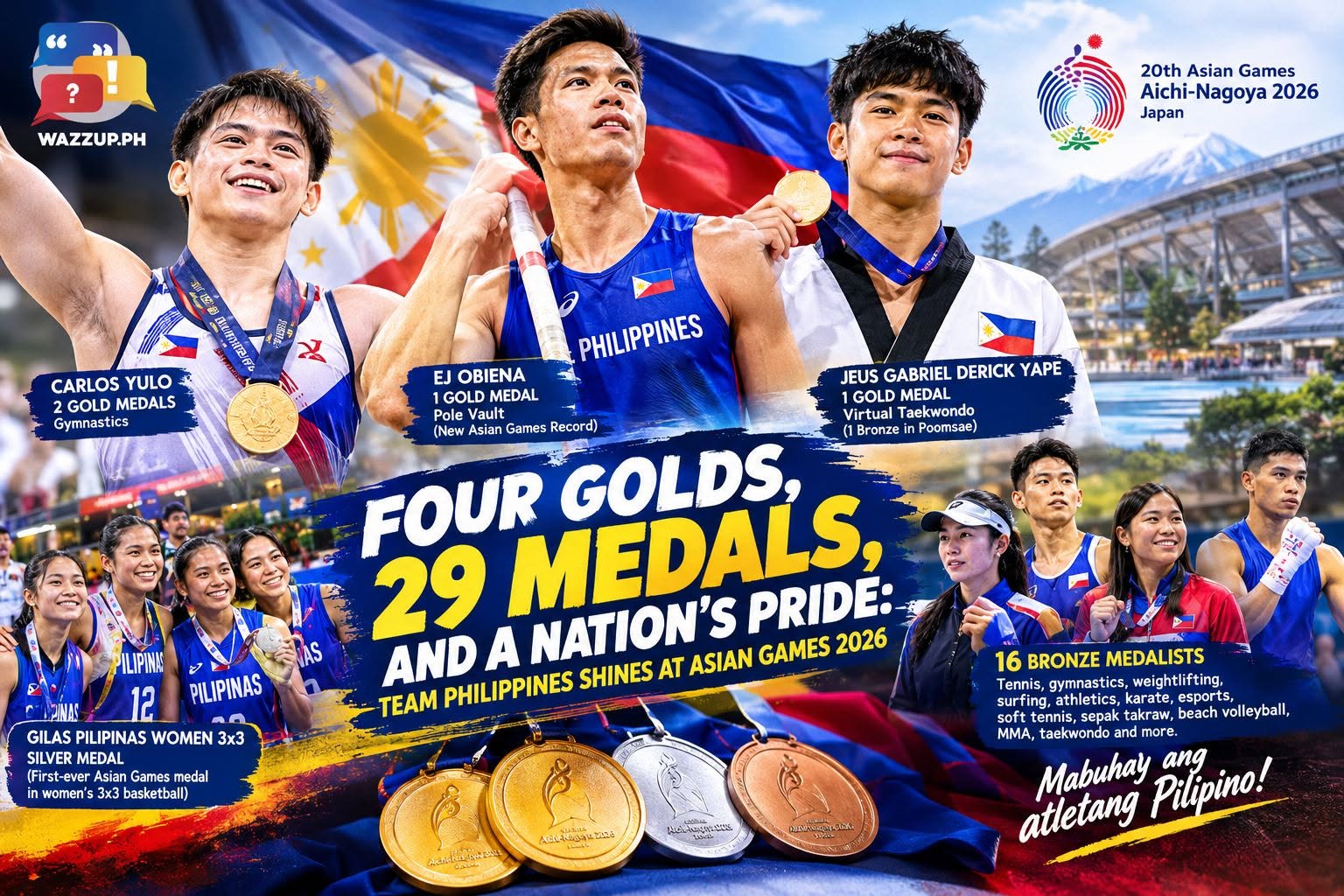
From Carlos Yulo’s historic gymnastics double to EJ Obiena’s record-breaking vault and Jeus Gabriel Derick Yape’s breakthrough in virtual taekwondo, Filipino athletes delivered a campaign defined by excellence, resilience, and milestones.
The Philippines may not have reached its target of eight gold medals at the 2026 Asian Games, but Team Philippines returned home with something far more meaningful than a number: a collection of historic achievements that reaffirmed the country’s place in Asian sports.
At the 20th Asian Games in Aichi-Nagoya, Japan, the Filipino delegation collected 29 medals—four golds, nine silvers, and 16 bronzes—to finish 17th overall. The competition concluded on October 4, marking one of the Philippines’ strongest performances at the continental sporting event in decades.
Behind every medal was a story of preparation, sacrifice, pressure, and the determination to represent the Philippine flag on one of Asia’s biggest sporting stages.
And while the gold medalists commanded the spotlight, the silver and bronze medalists also contributed to a campaign that deserves recognition beyond the final tally.
CARLOS YULO: A CHAMPION WHO CONTINUES TO MAKE HISTORY
When it comes to Filipino gymnastics, Carlos Yulo continues to demonstrate why he belongs among the country’s most accomplished athletes.
The two-time Olympic champion captured two gold medals in men’s artistic gymnastics, winning both the floor exercise and vault events.
His performance gave the Philippines two of its four gold medals and reinforced his standing as one of the country’s leading international sports figures.
Yulo’s victories were not simply about adding more medals to his collection. They represented the continuation of a remarkable journey built on technical precision, discipline, and years of competing against the world’s best gymnasts.
For Filipino sports fans, his achievements also carry a powerful message: excellence is not a one-time accomplishment but a standard that must be pursued repeatedly.
Yulo’s two-gold performance placed him at the center of the Philippine campaign, once again giving millions of Filipinos a reason to celebrate.
EJ OBIENA: SOARING ABOVE THE RECORD BOOKS
Another defining moment came from Filipino pole-vault star Ernest John “EJ” Obiena.
Obiena defended his Asian Games title in men’s pole vault, clearing 5.91 meters to establish a new Asian Games record.
His victory demonstrated the combination of strength, speed, technique, and mental composure required in a discipline where a fraction of a second and a small technical adjustment can determine the outcome.
Pole vaulting demands athletes to transform a sprint into a controlled, explosive movement that carries them over a bar suspended several meters above the ground. Obiena’s performance reflected years of dedication to mastering that demanding combination.
By defending his title and setting a new Games record, he reinforced his position among Asia’s premier pole vaulters.
His gold also underscored the Philippines’ growing competitiveness in athletics, a sport in which Filipino athletes continue to pursue opportunities on the international stage.
JEUS GABRIEL DERICK YAPE: A NEW CHAPTER IN TAEKWONDO
The Philippines’ fourth gold medal came from an athlete whose victory added a new dimension to the country’s Asian Games campaign.
Jeus Gabriel Derick Yape won the mixed individual virtual taekwondo title, defeating Vietnam’s Chau Ngoc Tuyet Sang in the final.
The victory was historic because it marked the first time the event was contested at the Asian Games.
Yape won the final 2–0, recording scores of 500–0 in the first round and 620–0 in the second. He also earned a bronze medal in men’s individual poomsae, making his campaign a double-medal achievement.
His success highlighted the changing landscape of competitive sports, where technological innovation is creating new formats that test athletes’ timing, technique, precision, and decision-making.
Yape’s gold was more than an addition to the medal table. It demonstrated that Filipino athletes can compete successfully in emerging disciplines while continuing to excel in established sports.
THE SILVER MEDALISTS: ACHIEVEMENTS THAT DESERVE THEIR OWN SPOTLIGHT
Although the Philippines fell short of its eight-gold target, the country’s nine silver medals told another important story: Filipino athletes repeatedly reached the final stages of competition against some of Asia’s strongest contenders.
Among those who earned silver medals were:
– Jean Claude Saclag — men’s traditional MMA, 65-kilogram division.
– Gilas Pilipinas Women 3×3 — a team featuring Kacey Dela Rosa, Amyah Espanol, Kennan Ka, and Maria Pasilang.
– Philippine women’s sepak takraw doubles team — Jean Marie Sucalit, Abegail Sinogbuhan, and reserve player Nelly Jay Salon.
– Amaya Amparo Cojuangco — women’s individual compound archery.
– Juliana Mykhail Candelaria — women’s individual taekwondo poomsae.
– Carlo Paalam — boxing, 55-kilogram division.
– Tachiana Mangin and Kurt Barbosa — taekwondo.
– Alexandria Enriquez — women’s jiu-jitsu, 63-kilogram division.
These performances reflected the diversity of Philippine sporting talent, from combat sports and precision events to team competitions.
The silver medalists may have finished one step below the top of the podium, but their accomplishments remain significant. Reaching a final at the Asian Games requires athletes to navigate multiple rounds of demanding competition, often against opponents supported by established national sports programs.
For Gilas Pilipinas Women 3×3, the silver-medal finish was particularly notable because the team secured the Philippines’ first Asian Games medal in women’s 3×3 basketball.
Their achievement opened another chapter in Philippine basketball, a sport traditionally associated with the country’s men’s teams.
THE BRONZE MEDALISTS: EVERY CONTRIBUTION COUNTS
The Philippines also collected 16 bronze medals, completing a medal haul that extended well beyond its headline-making gold medalists.
Among the country’s bronze medalists were tennis star Alexandra Eala, gymnast Eldrew Yulo, weightlifter Albert Ian Delos Santos, surfer Jayuard Alciso, hurdler John Cabang Tolentino, and middle-distance runner Victoria Bossong.
The medal-winning contingent also included athletes and teams from karate, esports, soft tennis, sepak takraw, beach volleyball, MMA, and taekwondo.
Each bronze represented an achievement in its own right.
For some athletes, the Asian Games provided another opportunity to establish themselves against the continent’s elite. For others, it marked a breakthrough that could help build confidence and momentum for future international competitions.
A bronze medal does not mean an athlete has fallen short of being worthy of recognition. It means that, in a highly competitive field, the athlete earned a place among the event’s medalists.
That distinction matters in a sporting environment where public attention can sometimes focus almost exclusively on gold.
BEYOND THE MEDAL COUNT: WHAT DOES SUCCESS LOOK LIKE?
The Philippines’ 29-medal finish invites a broader discussion about how the country evaluates success in international sports.
Medal targets can help sports officials measure progress and set expectations. However, they do not always capture the full value of an athlete’s performance, particularly when a delegation includes competitors in different stages of development and sports with varying levels of institutional support.
A gold medal can represent the culmination of years of preparation. A silver can reveal how close an athlete has come to the highest level. A bronze can establish a foundation for future success.
And performances that do not result in medals can still provide valuable international experience, expose areas for improvement, and help athletes prepare for subsequent competitions.
This does not mean medal targets should be abandoned or that disappointing results should escape scrutiny. Rather, both achievement and accountability must have a place in evaluating Philippine sports.
Questions about athlete development, coaching, training facilities, sports science, funding, and long-term preparation remain important if the Philippines hopes to sustain its competitiveness.
Celebrating medalists should go hand in hand with examining what can be done to help more Filipino athletes reach the podium.
A STRONGER CAMPAIGN, BUT ROOM TO GROW
The 2026 Asian Games concluded with the Philippines in 17th place, earning four golds, nine silvers, and 16 bronzes.
The final tally represented the country’s strongest Asian Games medal haul since the 1966 Bangkok edition, when the Philippines won 42 medals. Its four-gold performance also surpassed its three-gold total from the 2022 Hangzhou Games.
Those figures provide a reason for optimism, but they should also encourage reflection.
The challenge now is to turn individual victories into sustained national progress.
That means building stronger development pathways for young athletes, supporting medal contenders and emerging talents alike, and ensuring that success does not depend solely on a handful of established stars.
Carlos Yulo, EJ Obiena, and Jeus Gabriel Derick Yape have demonstrated what is possible at the highest level. The next task is to create an environment in which more Filipino athletes can follow their lead.
THE WAZZUP.PH TAKEAWAY: EVERY MEDAL HAS A STORY
The Asian Games are over, but the stories behind the medals remain.
Yulo’s double gold showcased world-class gymnastics. Obiena’s record-setting vault reaffirmed his continental dominance. Yape’s victory opened a historic chapter in virtual taekwondo.
Meanwhile, the silver and bronze medalists demonstrated the depth and variety of Filipino talent across numerous sporting disciplines.
The Philippines may have fallen short of its eight-gold target, but its 29 medals offered plenty to celebrate—and important lessons for the future.
Because national pride should not be measured by gold alone. It should also be measured by the opportunities created for athletes, the standards they establish, and the support they receive long after the applause fades.
For Team Philippines, the next challenge is clear: build on the achievements of Aichi-Nagoya and turn this generation’s breakthroughs into a stronger foundation for the next.
Mabuhay ang atletang Pilipino!