
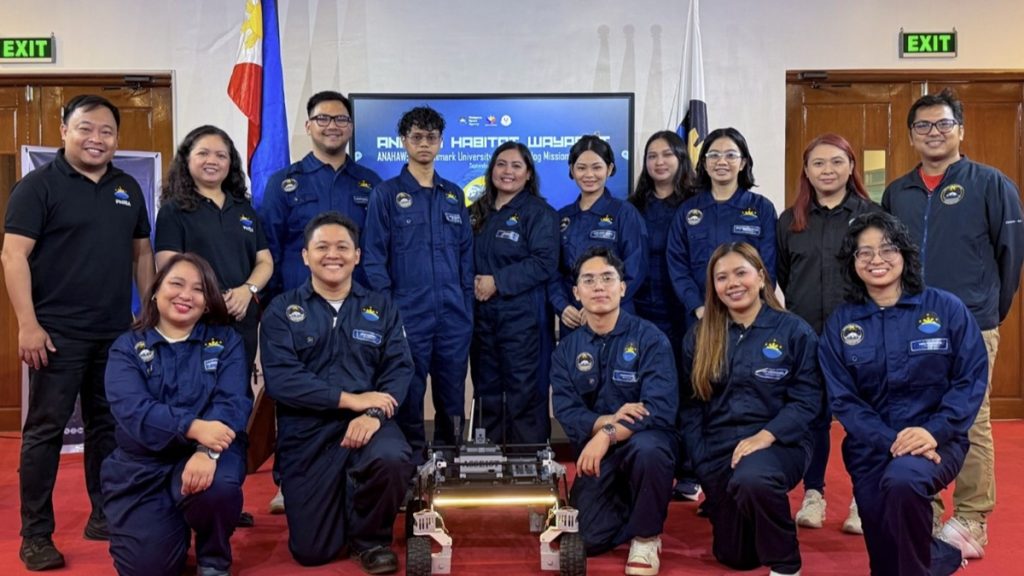
An all-Filipino crew has successfully completed the first Analog Habitat Waypoint (ANAHAW) mission of the Philippine Space Agency (PhilSA) on September 26, 2026. Conducted in partnership with Batangas State University (BatStateU) – The National Engineering University, the inaugural mission served as a benchmarking study for university-based analog missions in the Philippines.

Analog missions replicate key aspects of spaceflight and lunar or Martian habitats on Earth. They allow researchers and crew members to test systems, refine procedures, study crew dynamics, and strengthen operational readiness under conditions that simulate some of the challenges encountered during actual space missions.
The 24-hour inaugural mission took place inside a simulated lunar habitat at the BatStateU Alangilan Campus. It recreated mission scenarios involving isolation, limited resources, communication delays, and other challenges associated with space exploration.
The six-member crew brought together professionals from different fields, reflecting the interdisciplinary nature of human spaceflight. The team comprised Mission Commander Suguru Vaughn Hernandez, Flight Engineer Nathaniel Macato, Mission Scientists Bianca Angeline Alcantara and Yzhae Marrione Villaruel, Communications Officer Jeremaine Ko, and Health and Nutrition Specialist Mary Audrey Amorao.
Supporting the crew from the Mission Control Center were Flight Director Leemar Bonite, Capsule Communicator Cindy Lou Macahilos, and Science Technical Officers Angelo Manigo, Catherine Raisa Mandigma, and Erica Mae Santos.
Throughout the mission, the crew conducted a range of scientific experiments and technical demonstrations focusing on human-rover collaboration, a crew welfare mentoring system, crew dynamics during emergencies, surface microbial sampling, and ground-based germination screening of Philippine food crops.
Before the mission, all participants completed a six-part learning series on analog missions earlier in the year. The program introduced key concepts in analog mission operations and culminated in an assessment and group pitch, allowing participants to demonstrate their technical knowledge and teamwork.
Kristine Atienza, the Philippines’ first analog astronaut, provided technical inputs and helped PhilSA develop the mission concept. She also led the training sessions and mentored the crew in preparation for the inaugural mission.
For the Philippines, ANAHAW marks a significant step toward developing the country’s capability to design, implement, and evaluate analog missions for research and training. The first mission generated insights into scientific experimentation, analog mission operations, and habitat development that will help establish a framework for future missions and strengthen local expertise in human spaceflight support systems.
Following the successful mission, PhilSA plans to replicate the program in the coming years at more Philippine universities. The initiative aims to encourage academic institutions to participate in the growing Philippine space ecosystem by sharing expertise, knowledge, and resources to advance space science and technology initiatives.
“Over time, we hope to build the Philippines into a regional hub for analog missions, a place where people can come together to train, conduct research, and cultivate the knowledge and skills needed for human spaceflight. What begins here as a scientific experiment can grow into something larger: a community, a national capability, and new opportunities for the Philippine space sector,” said PhilSA Acting Director General Gay Jane Perez.
ANAHAW forms part of a broader pathway toward developing Filipino human spaceflight capabilities, encompassing analog missions, space science experiments, astronaut selection, and eventually, the training required for actual spaceflight.
“Our Filipino analog astronauts are already testing here on Earth what it takes to live and work beyond it. I look forward to the day when a Filipino takes that science all the way to space,” said President Ferdinand R. Marcos Jr.
The President made the statement after meeting with Filipino analog astronauts and PhilSA on September 24, 2026, to discuss the country’s analog mission initiatives, human spaceflight preparations, and efforts to develop Filipino capabilities for future space exploration.

Filipino analog astronauts Kristine Jane Atienza, Dr. Marvic Jon Alcantara, Florence Pauline Basubas, and Dr. Mark Angelo Purio have participated in international analog missions, including the Hawai’i Space Exploration Analog and Simulation (Hi-SEAS) program, the LunAres Analog Mission in Poland, the Monsaraz Mars Analog Mission in Portugal, and the ADAMA Analogue Astronaut Mission in Australia.
Through these experiences, they have gained valuable insights into crew operations, habitat systems, scientific research, and the challenges of long-duration missions in isolated environments. They also continue to promote space initiatives in the Philippines through mentorship and public outreach.
“That journey continues with our first all-Filipino analog mission team. PhilSA intends to build on this by bringing together more universities, researchers, students, and professionals to conduct analog missions, develop experiments, test technologies, and learn from one another,” said Director General Perez.
Through ANAHAW and related initiatives focused on developing human spaceflight support systems, PhilSA continues to create opportunities for Filipinos to learn, participate, and contribute to the country’s expanding space capabilities.