Through music, dance, striking visuals, and intimate storytelling, the production remembers the people behind the Manila Film Center tragedy.
Right before entering Tanghalang Ignacio Gomez at SM Mall of Asia, there is an unavoidable sight: the Manila Film Center.
For many Filipinos, the building has long been surrounded by stories of ghosts and “madaming mumu.” But beyond the folklore is a far more difficult history—the lives of workers who died during its construction, and the families who were left behind.
It is this human story that Tanghalang Pilipino’s Sayaw ng mga Ilaw brings to the stage.
Based on Cheeno Marlo Sayuno’s children’s book, the musical transforms a painful chapter of Philippine history into an intimate story of family, love, injustice, memory, and hope.
Rather than treating the Manila Film Center tragedy simply as historical spectacle, Sayaw ng mga Ilaw puts people at the center of the story.
A Terno That Says Everything
The production makes a statement before a single word is spoken.
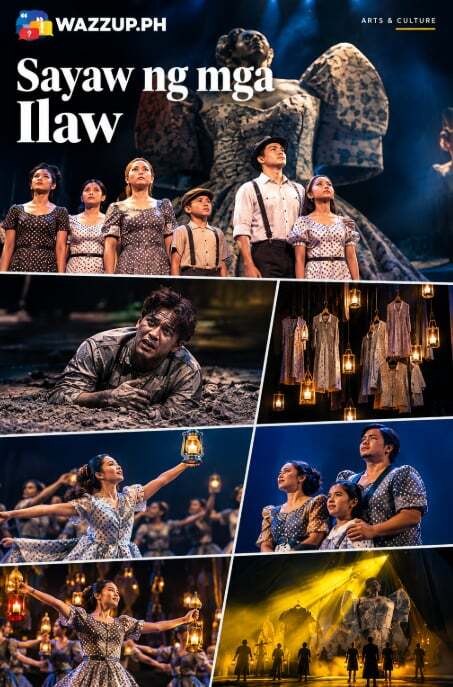
A gigantic Filipiniana terno dominates the stage, immediately establishing the visual world of the musical. Its imposing scale and deliberate crookedness create an image that is both grand and unsettling.
The oversized terno becomes more than a backdrop. It functions as part of the storytelling itself, carrying the weight of the era and eventually becoming central to one of the production’s most haunting sequences.
A World in Black, White and Polka Dots
The family at the heart of the story is dressed in polka-dotted costumes in shades of grey, black, and white.
The effect is almost cinematic—a world filtered through the look of an old photograph or film.
That restrained palette also makes the moments of color stand out. When music and dance take over, the stage suddenly feels more alive, creating a striking contrast between everyday life and the heightened theatrical moments.
The costume design quietly establishes both period and mood.
When History Becomes Visceral
The collapse of the Manila Film Center is one of the production’s most difficult moments to watch.
Noel Ramos as Tatay Ondeng delivers a particularly memorable performance as his character becomes trapped in the cement. The grey skirt of the enormous terno transforms into an image of concrete, creating the striking illusion of a man slowly disappearing beneath it.
It is a powerful piece of stage imagery.
Following the collapse, garments descend from above on hangers, accompanied by candles in glass cups. The clothes remain suspended for the remainder of the show, creating a visual memorial to the workers whose lives were lost.
The production’s approach is effective precisely because it does not reduce them to numbers or historical footnotes.
The Pandanggo Oasiwas That Hits Home
Among the show’s most affecting sequences is the Pandanggo Oasiwas.
While the more familiar Pandanggo sa Ilaw is commonly associated with courtship and romantic love, Pandanggo Oasiwas carries a different tradition, involving family members guiding fishermen safely back to shore.
In Sayaw ng mga Ilaw, that symbolism takes on a much heavier meaning.
When Laya dances for her father before he leaves for work, the moment is tender, familiar, and quietly devastating.
It is one of those scenes where a traditional Filipino dance becomes a language of family.
And yes, this reviewer cried.
Music That Takes Us Back
The music by Krina Cayabyab helps anchor the production in its period.
Some of the songs and musical passages evoke the sound of a 1970s radio, giving the story a distinct sense of time while complementing the emotional shifts of each scene.
The score does not merely accompany the action. It helps establish the atmosphere of the world the characters inhabit.
And after experiencing it live, one thought is hard to avoid:
A cast recording would be very welcome.
The Many Meanings of Light
Light is another recurring element throughout the production.
There is Nanay Lucia as the “ilaw ng tahanan,” Kala’s fire in confronting injustice, and light as a symbol of awakening for Laya.
The warm yellow lighting repeatedly cutting through the darker stage also creates a fascinating visual language. It suggests illumination emerging from a period marked by political and social darkness.
The result is a production in which lighting becomes part of the storytelling rather than simply a technical element.
A Children’s Musical With Something to Say
Despite the gravity of its subject, Sayaw ng mga Ilaw remains accessible as a family-oriented production.
Its foundation as a children’s book allows the story to approach difficult history through characters, music, movement, and visual storytelling rather than relying on exposition alone.
For younger audiences, it offers a story about family and courage.
For adults, the historical context provides another layer of meaning.
That makes the production unusually versatile: it can be experienced as a children’s story while still giving older audiences plenty to reflect on.
Tanghalang Pilipino’s Puso
The production also demonstrates the creative possibilities of adapting a children’s book for the stage.
At Kanto, members of the creative team shared insights into the process of transforming Sayuno’s book into a musical. That conversation revealed just how much work goes into translating a story from the page into live theater.
There is certainly more to unpack from that conversation—and more to come.
But perhaps the most striking quality of Sayaw ng mga Ilaw is its ability to keep the human story at the center.
The Manila Film Center may have become part of Philippine folklore, but the people associated with its tragedy were not folklore. They were workers with families, relationships, dreams, and lives beyond the construction site.
Tanghalang Pilipino gives that history a theatrical language—one built from Filipino music, dance, visual imagery, and, most importantly, puso.
Sayaw ng mga Ilaw runs until October 11 at Tanghalang Ignacio Gomez, SM Mall of Asia, with tickets priced at ₱1,800 to ₱2,000.
It is a production that looks backward without becoming trapped in the past—using theater to revisit a painful chapter of Philippine history and place the people behind it back at the center of the story.
Mabuhay, Tanghalang Pilipino.