For many creators, the high-octane world of First-Person View (FPV) drones like the Avata 2 has always been tantalizing but terrifying. The learning curve is very steep. Actually, I am still trying to learn it and still having a hard time. Even cinematic drones like the Mni 4 Pro that I own, it really requires good skills to get cinematic angles plus the pressure avoiding bird strikes, the strong winds in the islands. The “fear of the missed shot” is a heavy burden when you’re trying to balance complex flight physics with cinematic framing.
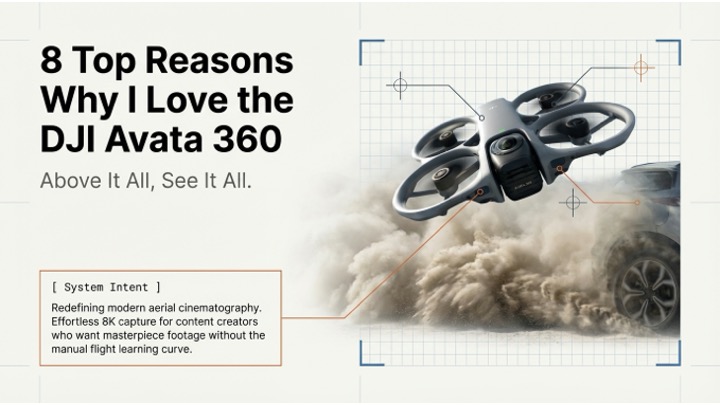
The DJI Avata 360 changes the calculus entirely. This isn’t just an incremental upgrade; it is a “perspective revolution tool.” By bridging the gap between immersive FPV thrills and the “shoot now, frame later” convenience of a 360-degree camera, DJI has packed the Avata 360 with technology that handles the “crazy stuff,” leaving you free to focus on the story.
Here are eight reasons why the Avata 360 is redefining the landscape of modern aerial cinematography making it easier for content creators and travelers who just want to get great vacation footages.
1. The Power of 8K Panoramic Imaging
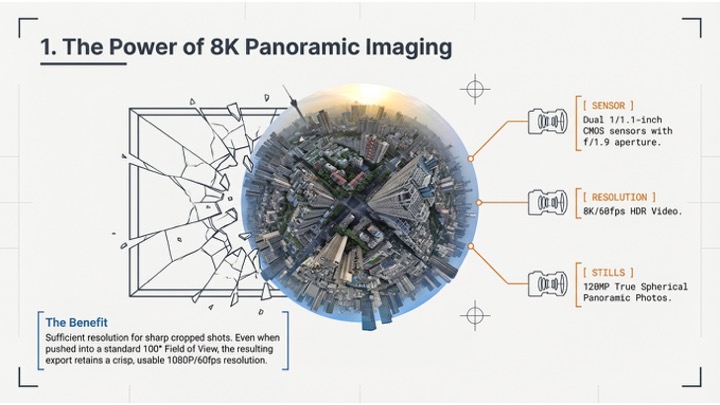
DJI has equipped the Avata 360 with a powerhouse imaging system featuring dual 1-inch-equivalent sensors (technical 1/1.1-inch CMOS). These sensors are capable of capturing 8K/60fps HDR video with massive 2.4 μm pixels. In the 360-degree realm, 8K isn’t a luxury—it’s the baseline for quality.
Think of 8K in 360 degrees as spreading pixels over a massive sphere. When you crop into that sphere to create a traditional 100° “flat” field of view for your final edit, you are effectively looking through a 1080p window. Without that initial 8K resolution, your cropped footage would crumble into a pixelated mess.
“8K/60fps HDR 360° video provides sufficient resolution for sharp cropped shots.”
For the professional colorist, the inclusion of D-Log M and Dual Native ISO (100 and 800) ensures that high-contrast scenes—like a sunset silhouette—retain clean shadows and highlight detail that can stand up to rigorous post-production.
2. Infinite Post-Production Creativity
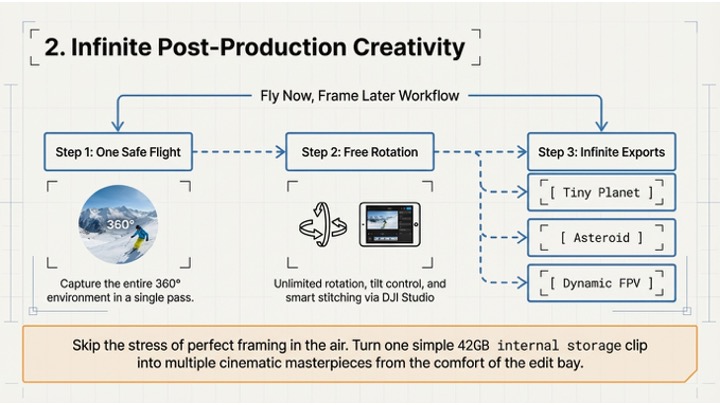
The real magic happens after the flight. The Avata 360 utilizes a “Virtual Gimbal,” offering infinite rotation and tilt control in post. This enables a “One Take, Multiple Creations” workflow that essentially eliminates the anxiety of missing a shot.
Using DJI Studio or the Fly app, a single flight path through a forest can be reimagined three different ways: an “asteroid” tiny-planet view for an intro, a “tunnel” view to emphasize speed, and a traditional follow shot to focus on the subject. You aren’t just recording a video; you’re capturing a 360-degree environment that you can direct long after the batteries are on the charger.
3. Professional Moves with Zero Skill (Spotlight Free)
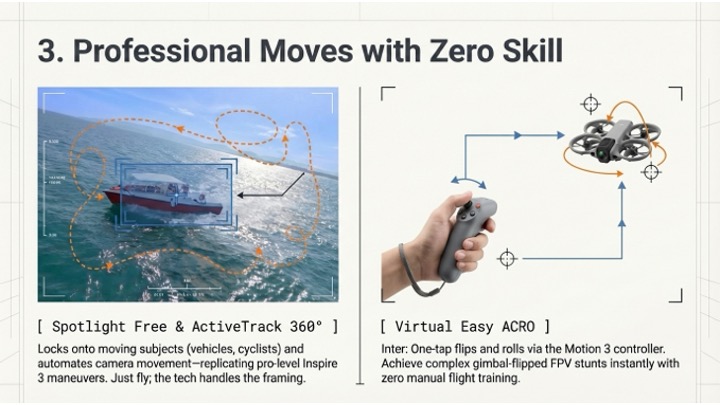
The barrier to entry for cinematic FPV has been slashed. DJI has integrated “Spotlight Free” and “Easy Acro” modes, leveraging tech originally found in the $16,000 Inspire 3. With the Motion 3 controller in hand, even a novice can achieve sophisticated camera language.
The “Free Mode” is particularly transformative. It allows the 360-degree footage to stay perfectly tracked on a subject regardless of the drone’s actual orientation or flight path, which significantly slashes your post-editing workload. You simply fly the drone near the action and let the internal algorithms handle the framing.
As one field tester noted:
“You don’t really need fpv skills anymore to get dynamic drone content… let the technology inside handle the crazy stuff.”
4. Nightscape-Level Safety with LiDAR
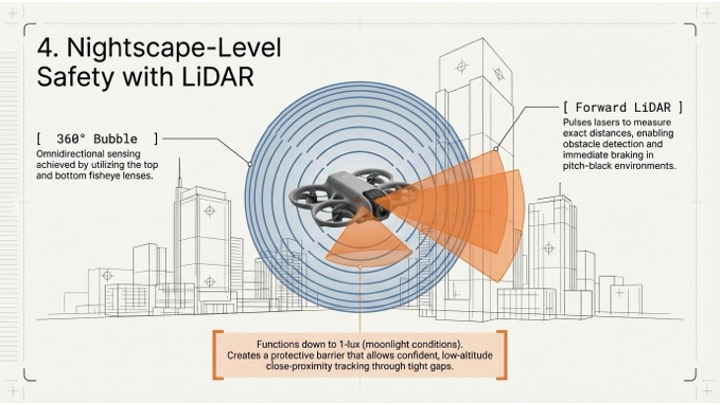
Safety is the foundation of creative confidence. The Avata 360 features a maxed-out omnidirectional obstacle sensing system that is a generational leap forward. By incorporating forward-facing LiDAR sensors, the drone can detect obstacles and initiate immediate braking in environments as dark as 1 lux—the equivalent of moonlight.
This “nightscape-level” safety allows beginners to fly through narrower gaps or in “pitch-black” conditions where traditional vision sensors would simply go blind. It turns what used to be a high-stakes gamble into a calculated, safe creative choice.
5. The Best of Both Worlds with Single Lens Mode
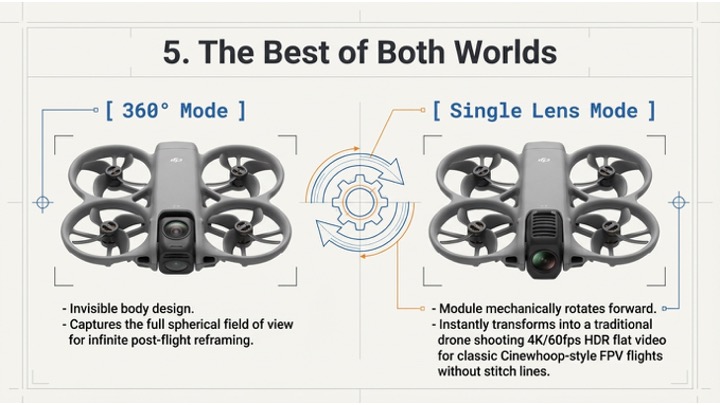
Sometimes, you don’t need a 360-degree view; you just need a rock-solid FPV shot. The Avata 360’s camera module physically rotates to enter Single Lens mode, transforming it into a traditional “flat” camera.
In this mode, the drone shoots 4K/60fps HDR video and an impressive 2.7K/120fps slow motion. This is the “get it done” mode for indoor “one-take” shots or flying in extremely tight spaces where you want to avoid any potential 360° stitching lines. It’s effectively two drones in one airframe.
6. Get Closer with Integrated Propeller Guards
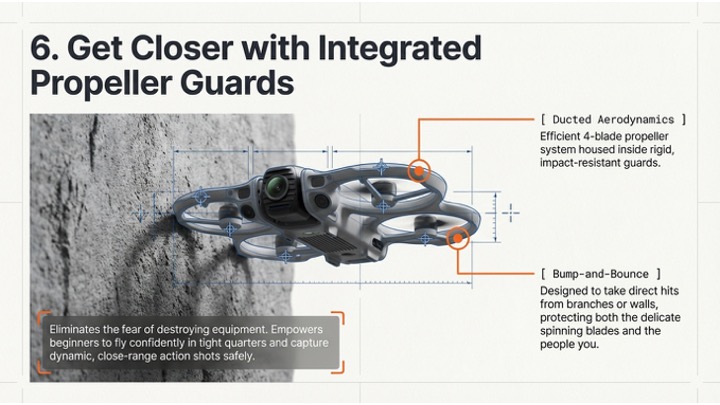
The “cinewhoop” design, featuring fixed, four-blade propeller guards, is built for proximity. While a drone like the Mini 5 Pro is a “bundle of joy” for wide-open landscapes, its exposed propellers make it a liability in tight quarters.
The Avata 360 is designed to “brush” against obstacles or fly safely near people. This physical protection encourages the kind of bold, close-range creative flying that defines modern social media content, allowing you to get the camera into spots that traditional aerial photography drones wouldn’t dare.
7. Flagship O4+ Transmission Stability
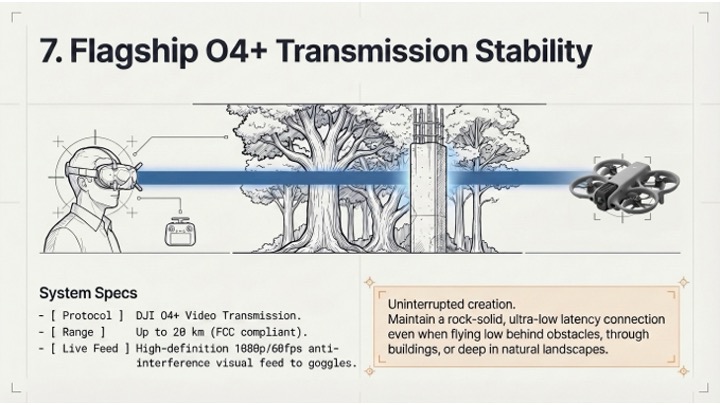
An immersive FPV experience is only as good as the live feed. The Avata 360 utilizes the flagship O4+ transmission system, providing a 1080p/60fps HD live feed to your goggles. With a rated range of up to 20km (FCC), the signal reliability is exceptional. Even when weaved through dense forests or behind urban obstacles, the connection remains stable, ensuring you never lose that vital “pilot-in-the-cockpit” sensation.
8. Thoughtful “No-Repair” Maintenance
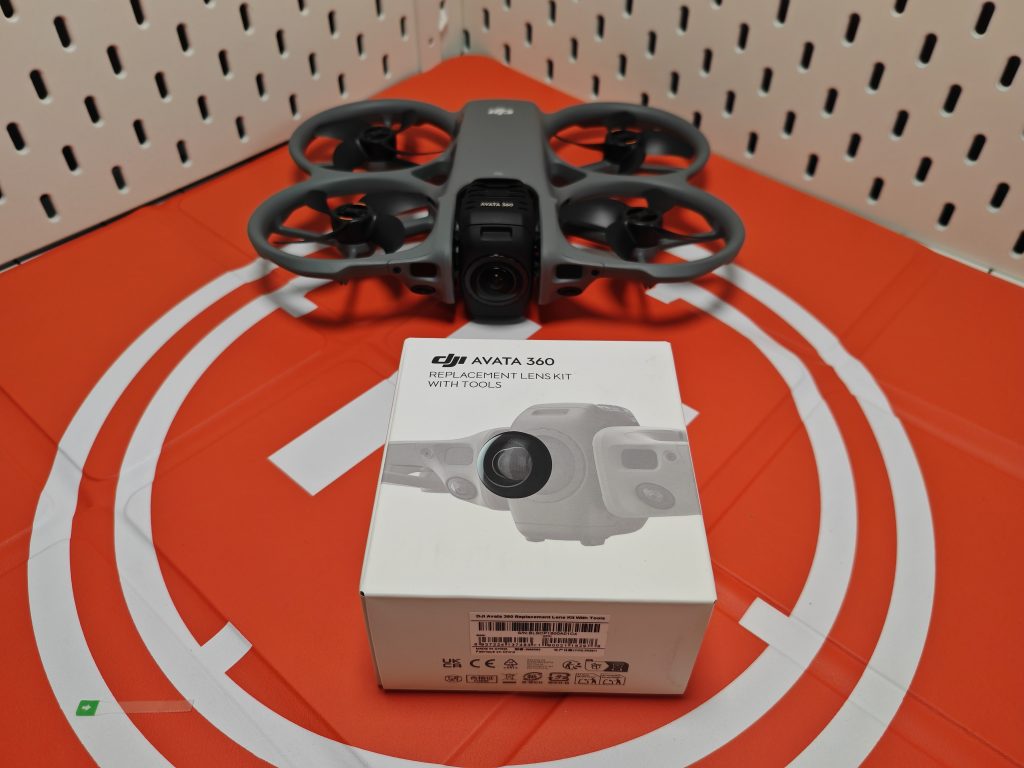
DJI has finally addressed the FPV community’s biggest headache: the scratched lens. The Avata 360 features a user-replaceable front lens element. If you take a spill, a simple kit with tools allows you to swap the glass yourself rather than shipping the unit back to a factory.
Additionally, the drone includes 42GB of internal storage. While this is a fantastic safety net for those “I forgot my microSD card” moments, a critical eye should note that 42GB only holds about 30 minutes of 8K footage. For a full day of shooting, high-capacity microSD cards remain an absolute essential.
Summary: Pros, Cons, and the Bottom Line
The DJI Avata 360 is a specialized tool that prioritizes immersive storytelling and creative flexibility over raw racing performance.
Pros
- Infinite Reframing: Capture the entire environment and choose your angle in post.
- LiDAR Safety: Forward-facing LiDAR allows for 1-lux (moonlight) obstacle avoidance.
- 120MP Stills: Incredible resolution for true spherical panoramic photography.
- No-Skill Acro: One-tap flips and rolls via the Motion 3 controller.
- Replaceable Lens: User-serviceable design keeps you in the air longer.
Cons
- Weight & Class: At ~455g, this is a C1 class drone, requiring specific registration/regulations.
- Propeller Noise: The efficient four-blade system is still quite loud and draws attention in public.
- Limited Manual Control: It lacks a full manual “Acro” mode for professional FPV racers.
- Visible Stitch Lines: While rare in final exports, stitch lines can occasionally appear when flying very close to subjects.
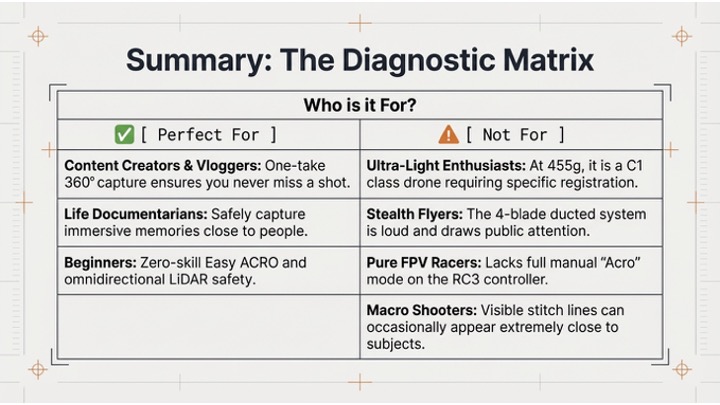
Who This Drone is For: Content creators, high-end “life documentarians,” and beginners who want to capture dynamic, high-stakes FPV shots without the years of manual flight training.
Who This Drone is Not For: Pure manual FPV racers, professionals requiring a silent flight profile, or ultra-lightweight enthusiasts who must stay under the 250g weight limit.
Conclusion: A New Era of Aerial Storytelling
The DJI Avata 360 represents a fundamental shift in how we capture the world. By removing the stress of perfect framing and the steep learning curve of manual flight, it allows the creator to remain present in the moment while the technology secures the masterpiece. When you can capture the entire world in a single take, what story will you choose to tell first?
PRICE IN THE PHILIPPINES
Pre-order from March 26-April 8, 2026. Release Date: April 9, 2026
DJI AVATA 360 (DJI RC 2) WITH 1 BATTERY – P38,290
DJI AVATA 360 FMC (DJI RC 2) WITH 3 BATTERIES – P47,890
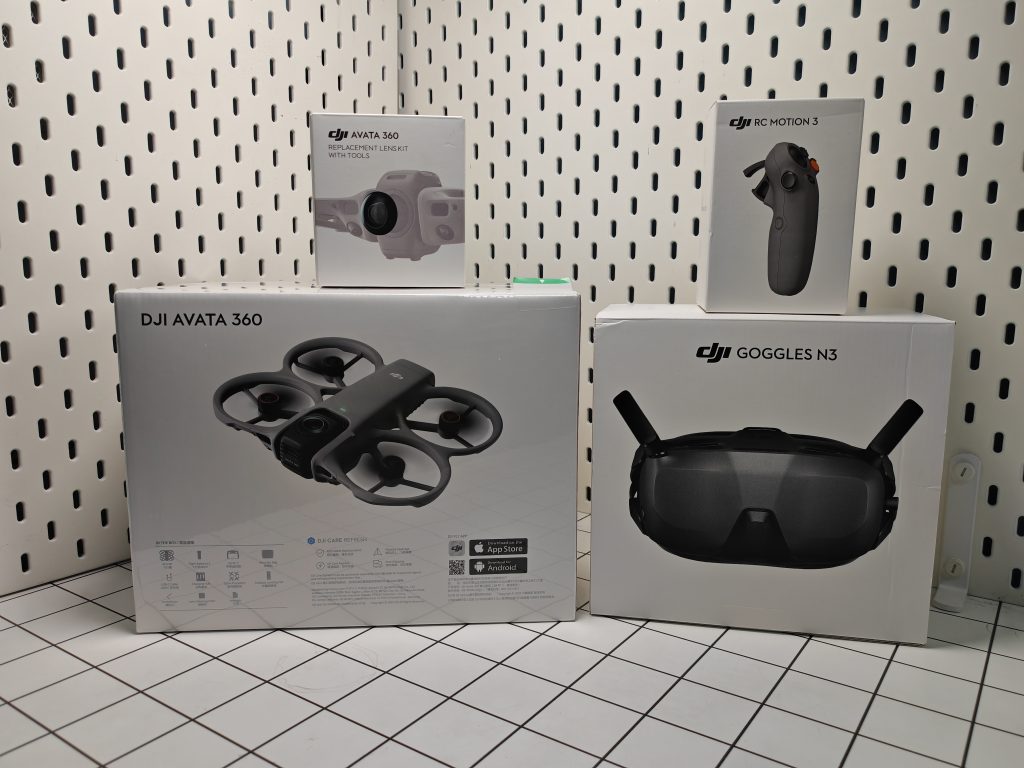
DJI AVATA 360 MOTION FMC- P47,890 with Googles N3 and Motion 3 controller and 3 Batteries