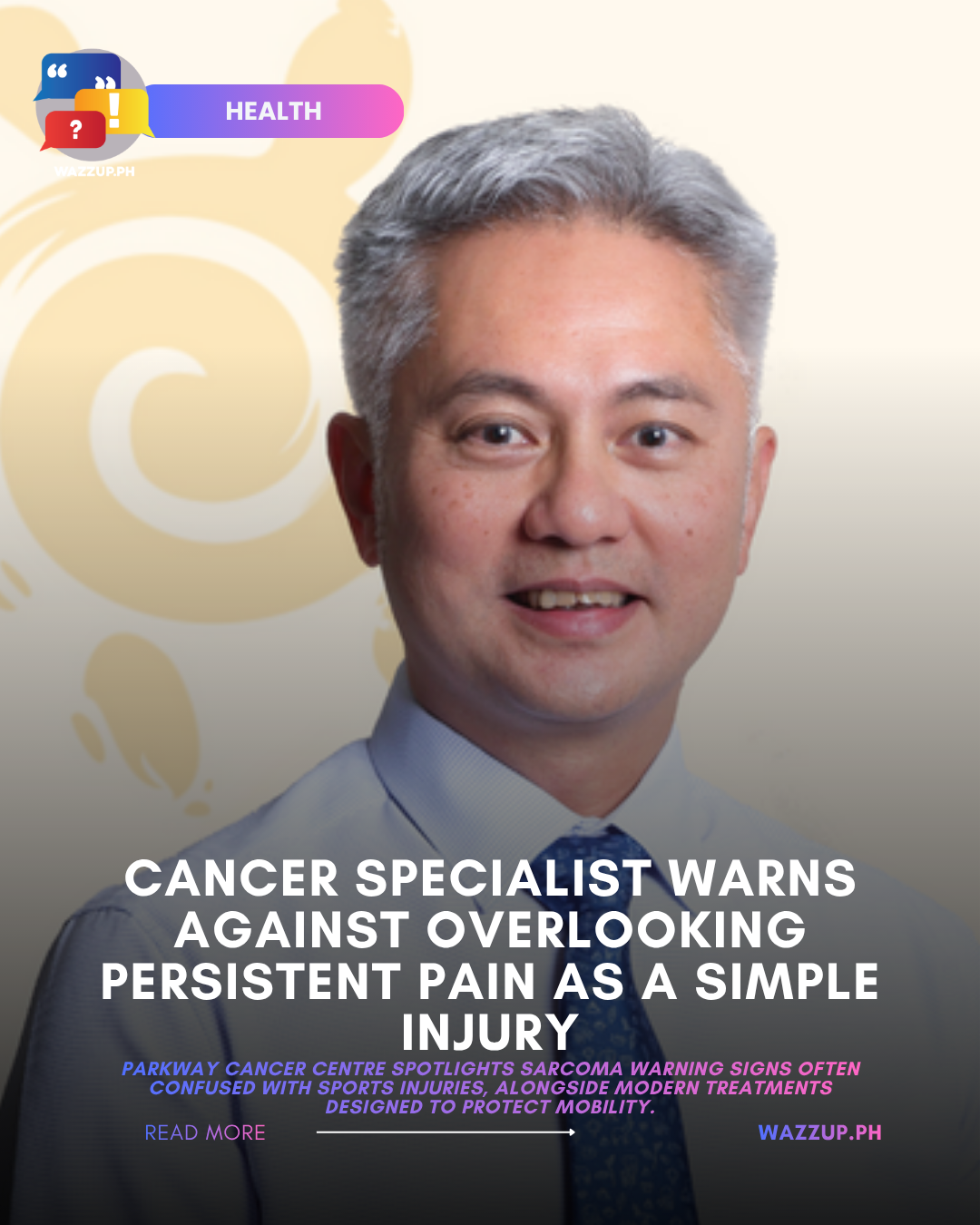
Parkway Cancer Centre spotlights sarcoma warning signs often confused with sports injuries, alongside modern treatments designed to protect mobility.

Manila, Philippines — For people with active routines—whether playing pickleball, running on weekends, lifting weights, or hiking—sore muscles and minor strains are part of life. Still, ongoing pain shouldn’t always be brushed off as a typical workout injury, especially if it flares up at night or lingers while resting, warns an oncologist from Singapore’s Parkway Cancer Centre (PCC).
Although the vast majority of post-exercise aches are nothing to worry about, stubborn or unexplained pain can occasionally point to something more serious. One possible culprit is sarcoma, a rare form of cancer that forms in the bones or soft tissues like muscles, fat, and blood vessels.
“People who lead active lifestyles tend to know their bodies well, but that familiarity can sometimes lead them to underestimate unusual symptoms. What matters is recognizing when discomfort no longer follows the usual pattern of recovery,” said Dr. Richard Quek, Senior Consultant, Medical Oncology at Parkway Cancer Centre. “Seeking medical advice early can help identify the underlying cause and determine the appropriate next steps.”
Why it’s easy to overlook
Sarcoma can strike at any age, though specific subtypes tend to affect different age brackets. For example, osteosarcoma and Ewing sarcoma are seen more often in children and young teenagers, whereas other varieties typically appear in adults.
For active people who naturally chalk up soreness to their workouts, these early red flags are easily confused with everyday sports injuries—a mix-up that can delay a proper diagnosis.
Symptoms largely depend on where the tumor grows. Bone sarcomas often trigger ongoing or escalating pain that tends to feel worse at night. In contrast, soft tissue sarcomas frequently show up as an enlarging lump or unexplained swelling that might not hurt at all.
Doctors urge anyone dealing with pain that refuses to fade with rest, worsens for no clear reason, or comes with unexplained swelling or a growing mass to get checked out.
While these signs don’t automatically mean cancer, getting evaluated early helps pinpoint the true cause. Based on an initial exam, physicians might order imaging scans or a biopsy to confirm a diagnosis.
New treatment breakthroughs bring hope
Because there are over 70 known subtypes of sarcoma, no two treatment plans look exactly alike. At Parkway Cancer Centre, a team of specialists—including medical and radiation oncologists, surgeons, pathologists, and radiologists—works together to tailor care around each patient’s exact diagnosis and health profile.
Depending on the case, care may involve surgery, chemotherapy, radiation, or a mix of these methods. Subtypes like Ewing sarcoma and rhabdomyosarcoma, for instance, respond especially well to chemotherapy, underscoring why personalized care matters.
Modern surgical innovations now allow eligible bone cancer patients to undergo limb-sparing procedures that protect their movement and physical function. At the same time, advanced options like proton therapy deliver radiation with pinpoint accuracy, helping shield nearby healthy tissue from unnecessary exposure.
Ultimately, these medical strides go beyond simply fighting the disease—they focus on helping patients preserve their independence and everyday quality of life.
“Treating sarcoma goes beyond removing the cancer. We also want to help patients preserve their mobility, independence, and quality of life. I recall the case we had of a 23-year-old bone cancer patient who underwent limb-salvage surgery and was eventually able to return to activities like rock climbing. This shows how personalized treatment can help patients regain not just their physical function, but also the freedom to pursue the activities they love,” Dr. Quek shared.
Parkway Cancer Centre reminds active individuals that while minor muscle soreness is a normal part of staying fit, lingering or unexplained pain shouldn’t be brushed aside. Consulting a doctor early ensures an accurate diagnosis and timely, proper care. For more information on sarcoma and available treatment options, visit www.parkwaycancercentre.com/ph.